A First Encounter with a Christian Worldview Is the Simplest Introduction You'll Find

These days, the word "worldview" turns up in more places than we might expect. It surfaces in lectures, in reflective videos and books meant to help us examine our lives. Secular culture uses the term freely enough, but within the church it has become almost inescapable — we hear it from the pulpit on a Sunday morning, and find it printed in our small-group Bible study materials. And yet when someone actually asks what a worldview is, let alone what a "Christian worldview" is, most of us find ourselves reaching for words that don't quite come.
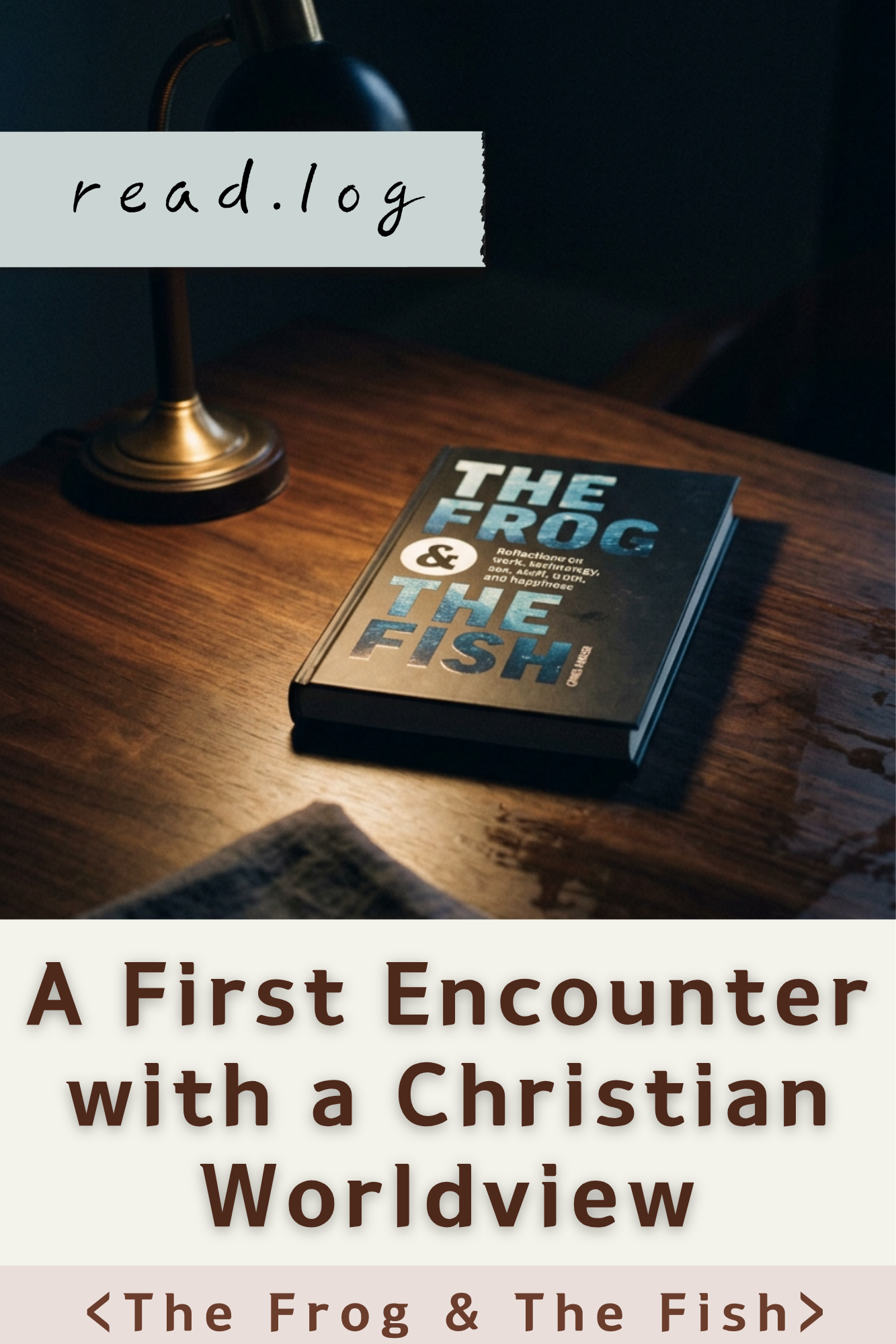
Most of us use the phrase freely precisely because we've rarely had to define it, and the difficulty becomes obvious the moment we try. Much of the literature on worldview doesn't help, either — so many of these books are written in a philosophical register that erects its own barrier to entry. The book I'm reviewing for read.log today is the exception. Published in Korea as A First Encounter with a Christian Worldview — and originally released in Australia by Chris Parker as The Frog and the Fish: Reflections on Work, Technology, Sex, Stuff, Truth, and Happiness — it is, among every book on Christian worldview I have read, the most accessible. It may be the simplest introduction to a Christian worldview you'll find. Let's look at what makes it so.
A Worldview Begins with How We See Ourselves, the World, and Justice

A worldview, put simply, is the lens through which we see the world — the framework of assumptions we bring to everything we encounter. That's why it's so often compared to a pair of glasses. Understanding a worldview requires attention to three things: the self doing the looking, the world being looked at, and justice, the value that world is meant to embody. This book takes up each of these in turn, and lightly. Parker's years teaching in secondary-school classrooms show; he has a gift for handing readers complex ideas without making them feel the weight of it.
He begins by surveying the ways our culture understands what it means to be human and how it imagines the world we live in, before finally turning to a biblical account of both. Two convictions anchor everything that follows, he insists: that human beings are made in God's image for the purpose of glorifying him, and that God declared his creation good, calling us to use what he has made — within that good creation — to delight in him and give him glory.
Living in this fallen world, we often wonder why God's creation isn't more just. Parker's answer is unflinching: sin. But he doesn't stop there. He goes on to press the harder question of what we're meant to do about it.
"Conquering evil is God's job. Our part is to join him in the justice and mercy he is bringing about — stepping into the world's injustices and life's hardest issues to do his work there.”
Every Sphere of Creation Must Be Reformed by a Christian Worldview
As Parker has already shown, sin has left the world looking very different from what God intended when he made it. We come to see that many of the good things God created have been twisted from their original purpose. Work, technology, sex, and consumption — the ordinary stuff of daily life — have all been distorted along with everything else, and Parker doesn't let readers look away from that.
This conviction places him squarely in the tradition of Abraham Kuyper, the father of modern Christian worldview thinking, and his doctrine of sphere sovereignty. There is not one square inch of the whole of creation, Kuyper famously said, over which Christ does not claim sovereignty. If that's true, then our task is plain: to reform every distorted sphere of life back toward the shape God intended for it.
A First Encounter with a Christian Worldview helps readers do exactly that kind of thinking for themselves. It names how each sphere has been distorted today, shows how a Christian worldview reframes it, and points toward how we might begin to change it. What sets the book apart is the questions it leaves with readers at the end of each section — not abstractions to file away, but prompts meant to be carried into daily life. That, more than anything, is its greatest strength.
Truth, Too, Must Be Understood Within a Christian Worldview

One of the book's more important sections concerns truth itself. We often name the outlook that governs our age postmodernism, or relativism: a sensibility in which every absolute has been softened, and every claim is understood only in relation to something else. Under these conditions, truth has weakened more than in any prior age. Parker points out how often we're told to locate truth in science, in collective consensus, or simply in what we feel — and how each of those authorities, on its own, falls short of telling us what is actually true.
To understand truth rightly, he argues, we have to return to what Scripture itself says. Truth, like everything else, only comes into focus within a Christian worldview. In the end, this is simply the old Reformation watchword in new clothes: sola Scriptura — Scripture alone.
"God's Word is the highest authority we have for truth in every area of life.”
I Recommend This Book to Anyone New to a Christian Worldview
A First Encounter with a Christian Worldview was not written by a theologian or a Christian philosopher, and it doesn't try to be. Readers looking for academic depth, or scholars researching worldview theory, should look elsewhere. But that's precisely the point: most serious books on Christian worldview are simply too dense for ordinary readers to pick up.
For believers who face these distorted spheres of life every day, this book offers something rarer than depth — clarity. It shows what a Christian worldview looks like and invites readers to consider what God wants from them within it. For teenagers, young adults, and anyone meeting a Christian worldview for the first time, this is required reading.
About Author

faith.log
A journal that connects faith and everyday life. In each small piece of writing, we share the grace of God and the depth of life together.


