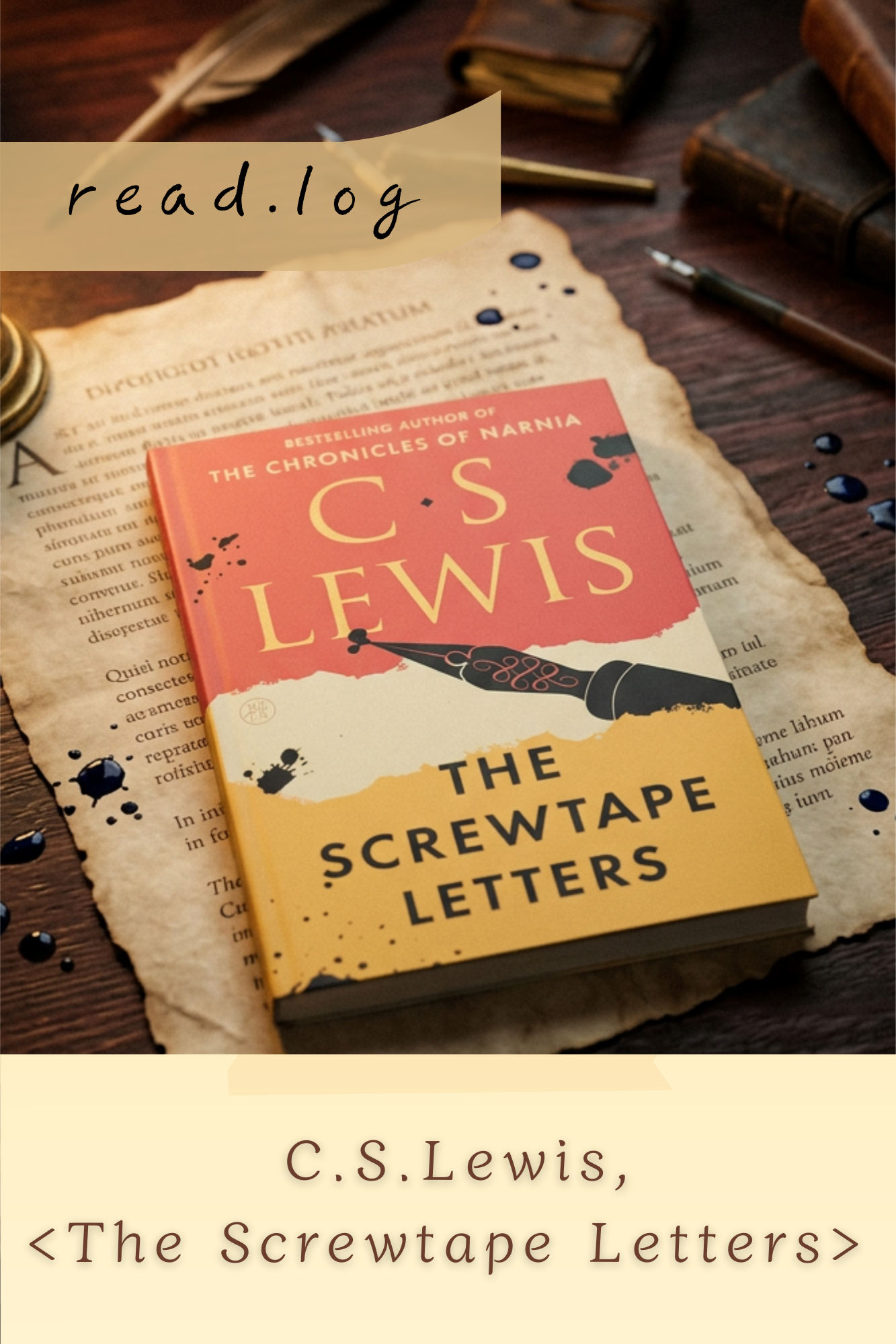
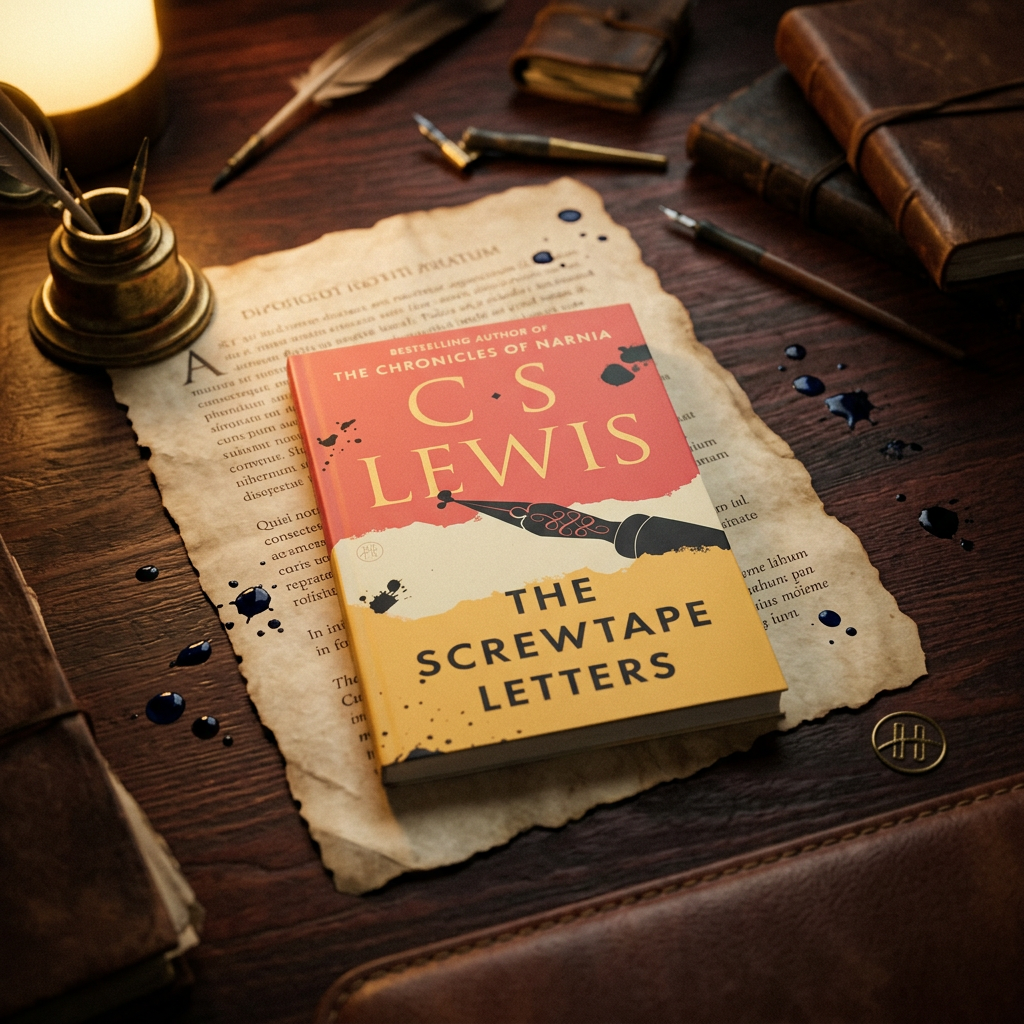
In our last read.log Ⓕ, we explored C.S. Lewis's Mere Christianity. This time, I'd like to continue that conversation with The Screwtape Letters. Where Mere Christianity focused on laying out the essentials of the faith — what we believe and how we ought to live — in clear, accessible language, The Screwtape Letters takes a strikingly different approach.
Lewis tells his story from the perspective of the demonic camp, through the eyes of those who exploit human weakness for their own ends. This unusual narrative device forces the reader to confront a sobering question: what exactly are the vulnerabilities the enemy is targeting in us? In doing so, the book illuminates the subtle ways we drift from faith — and just as importantly, how the grace of the Lord meets us at those very points of failure.
Examining Our Faith in Seasons of Comfort

The Screwtape Letters is structured around thirty-one letters from Screwtape, a senior demon, to his nephew Wormwood, a junior tempter assigned to corrupt a young human patient. Screwtape advises, coaches, and occasionally scolds Wormwood as the assignment unfolds. Through these letters, the reader is granted an unsettling inside view of how the demonic mind reads and exploits human nature.
What emerges from that view is deeply convicting — because it overturns one of our most common assumptions. Most of us tend to think that the enemy does his most dangerous work during times of crisis: illness, grief, failure, loss. But Screwtape dismisses this approach as crude and unreliable. The far more effective strategy, he tells Wormwood, is to work through comfort.
"The safest road to hell is the gradual one — the gentle slope, soft underfoot, without sudden turnings, without milestones, without signposts."
Reflecting on my own life here in New York, I find this uncomfortably accurate. The seasons when my faith has been most alive and attentive have almost always been the hard ones — the years of uncertainty, of loss, of being brought to the end of myself. It's the quiet, comfortable stretches that expose me. The paycheck arrives, the family is well, the calendar is full — and somewhere in all of that ease, the anchor begins to drag. This is precisely what Lewis is warning us about.
Discerning Between Pleasure and Counterfeit Joy

There's a strain of Christian piety — more common than we'd like to admit — that treats pleasure itself as suspect. Lewis will have none of it, and rightly so. The enjoyment of good things given to us by God is not sin. The problem, as Screwtape makes clear, is not pleasure but the counterfeit version of it: cheap, hollow substitutes that crowd out the genuine article.
"Did you not foresee that your elaborate work on his pleasures would one day be exposed for what it is — rendered worthless by a single moment of comparison?"
We surround ourselves with an enormous quantity of low-grade amusements — and the insidious thing is that we rarely recognize them for what they are. We're not choosing sin over goodness; we're choosing a lesser good over a greater one, and we never quite notice the trade we've made. The hours accumulate. The time given to us gets swallowed up.
Which brings Lewis to a point that cuts even deeper: our distorted relationship with time itself. We speak of "my time" as though it were a personal possession — something we've earned, something we're owed. Screwtape identifies this assumption as one of his most reliable tools.
"You must zealously guard in his mind the curious assumption that time is 'his own' — that no one else has any claim on it."
"Man can neither make, nor retain, one moment of time; it all comes to him by pure gift."
This is the Reformed understanding of stewardship in its most elemental form: everything we have — including every hour of every day — is gift, not possession. To receive time and pleasure as grace, and to use them accordingly, is an act of worship. To forget that is to hand the enemy exactly what he's looking for.
Guarding Against the Corruption of Faith

If Mere Christianity maps the territory of orthodox belief, The Screwtape Letters shows us where the roads off that map lead — and how easily we wander onto them. Reading it as someone who watches the American church closely, and keeps an eye on what's happening in Korean Christianity as well, I found the warnings land with uncomfortable precision.
The most timely of them concerns the boundary between faith and politics. Screwtape identifies this border as prime territory for demonic exploitation — and it's not hard to see why. Across much of the Western church today, political engagement has quietly become a proxy for spiritual identity. People confuse activism for discipleship, tribal loyalty for theological conviction. The result is a faith that has been, in Lewis's terms, thoroughly weaponized — and a church that is driving people away rather than drawing them in.
"The best possible position is one on the borderline between Faith and Politics."
But the warning that struck me most deeply was the one about treating Christianity as a means to an end. This is, I would argue, the central spiritual disease of our age. The Westminster Shorter Catechism is unambiguous on the point: the chief end of man is to glorify God and enjoy him forever. Not to leverage God for personal success. Not to use the church as a networking platform or a source of cultural credibility. And yet this is precisely the pattern Screwtape celebrates as his finest achievement.
"What we want, if men become Christians at all, is to keep them in the state of mind I call 'Christianity And' — Christianity and the Crisis, Christianity and the New Psychology, Christianity and the New Order... if they must be Christians, let them at least be Christians with a difference."
When faith becomes instrumental — a tool for achieving something else — it has already ceased to be faith in any meaningful sense. It is, as Lewis shows us, exactly where the enemy wants us.
A Book I'd Press Into Every Reader's Hands

Reading The Screwtape Letters, I kept having the uncanny feeling that Lewis had somehow written it for this particular moment. The vulnerabilities Screwtape catalogs — the politicized congregation, the prosperity-gospel mindset, the slow drift of the comfortable life — are not historical curiosities. They are the daily reality of the church in 2026.
What makes this book so valuable is precisely its function as a mirror. It doesn't just describe the enemy's tactics in the abstract; it holds them up against your own life in ways that are hard to deflect. Reading it, I found myself tracing the contours of my own susceptibilities — the places where the world has the most purchase on me, where the drift begins.
In an age that increasingly measures everything by material outcomes and has largely lost the ability to ask what is this for?, The Screwtape Letters is the kind of book that restores the question. It slows you down. It makes you look again at the life you're actually living — not the one you think you're living.
"The whole purpose of the book is not to speculate about diabolical life, but to throw light from a new angle on the life of men."
That new angle is one we badly need. I commend it to you without reservation.
About Author

faith.log
A journal that connects faith and everyday life. In each small piece of writing, we share the grace of God and the depth of life together.


