
Botchan: Why Does Honesty Always Cost Something?

There was a stretch when the personality test everyone reached for was the MBTI. It promises to tell you who you are by sorting your traits into a four-letter type. But somewhere along the way, a curious qualifier crept into how people talk about their results: socialized. A "socialized MBTI" versus an "unsocialized" one. It's a small phrase, but it reveals something larger — even a test built to help you understand your own nature ends up grading you on how well you've been shaped to fit into everyone else’s.
We tend to assume that becoming socialized is simply the mark of maturity. I don't want to dismiss that outright; living alongside other people requires real adjustments. But I do think it's worth asking whether socialization, as we practice it, is actually just. Natsume Sōseki's Botchan is the novel that keeps pulling me back to that question.
Botchan's honesty stands against the age's polish
Most people, when they think seriously about getting ahead, think about social skill — the art of reading a room, managing impressions, knowing which words to reach for and when. Dale Carnegie's How to Win Friends and Influence People remains a staple on office bookshelves nearly a century after it was written, which tells you something about how durable this instinct is. And why wouldn't it be? In a market economy, the polished get ahead. What rarely gets asked is whether getting ahead this way is actually right.
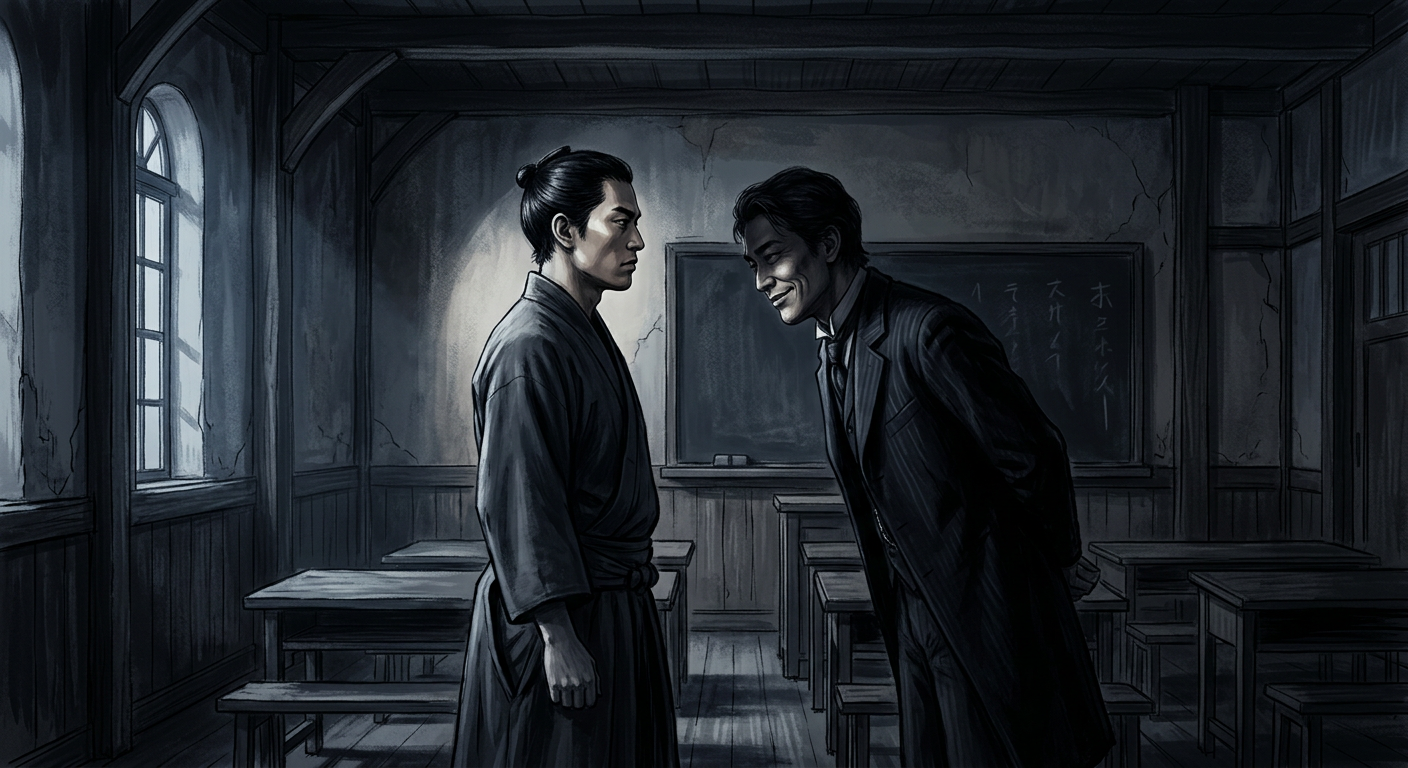
Botchan puts that question on the page. Its narrator — nicknamed Botchan, "young master," a term of endearment rather than a name — is temperamentally incapable of the maneuver. Sōseki plays this for comic effect throughout the novel, but strip away the humor and what's left is simply honesty, unable to bend. Everyone arrayed against him has, in one way or another, learned to bend. The contrast is the whole architecture of the book; Sōseki isn't just telling a story, he's asking which of these postures deserves our respect.
The plot sets this up cleanly. Botchan leaves Tokyo for a teaching post on a rural island in Shikoku — his first real exposure to working life outside the world he knows. There he collides with Red Shirt, the vice principal, a man whose every move serves his own ambition, and with the toady art teacher who flatters Red Shirt for scraps of advantage.
The sharpest exchange in the book comes when Red Shirt offers Botchan some worldly advice: no one succeeds by living out what they learned in school. Botchan's answer — that honesty matters more than anything — should needle any reader who has told themselves that flexibility is just the price of getting by. It's worth asking, coram Deo, whether what we call flexibility is really just material gain outranking the moral claims of honesty and fairness in our own hearts.
"Most people in this world seem to think it's only natural to go astray. They seem to believe you can't succeed in this society without getting a little dirty. And when they meet someone genuinely honest and unspoiled, they sneer — 'well, look at the young master, must be nice.' If that's really how it is, our elementary and middle schools shouldn't be teaching children not to lie and to be honest. They should be teaching the art of lying, the technique of suspecting your neighbor, the tricks of swindling people — that, apparently, would serve the world, and the child, far better."
Botchan chooses honesty over advancement

Red Shirt wields his position without apology. He uses the rank of vice principal, and every relationship that rank buys him, to get what he wants. He tries to buy Botchan too, dangling a raise to bring him into his camp — Botchan turns him down flat. When Red Shirt maneuvers to force out the teachers who stand in his way, Botchan doesn't stay quiet; he fights back, hard.
When Porcupine, the head of mathematics, is finally driven out by Red Shirt's scheming, Botchan joins him in exposing what Red Shirt has done. And once that's finished, Botchan doesn't stay to enjoy the vindication — he resigns his teaching post outright and takes a job on the railway at half his former salary.
Sōseki doesn't reward Botchan's honesty with success. If anything, the novel confirms what most of us already suspect from watching our own lives: the honest tend to come out behind. And yet that's precisely the point Sōseki is making — that honesty, loyalty, and fairness sit above material success in the actual order of things, whether or not the ledger ever shows it.
"If you live honestly, you've got nothing to fear, no matter who tries to use you."
A person's character is completed by the one who believes in it

One more figure carries real weight in this novel. Botchan's refusal to bend has caused him trouble since childhood, and his own family mostly responded by criticizing him for it. But one person stayed beside him the whole way through, insisting that his honesty was not a flaw to be corrected but a virtue to be trusted. That person is Kiyo, his old nurse. She's there in his childhood, through his school years, when he takes the teaching post in Shikoku, and again at the very end, when he returns to Tokyo and joins the railway. Her love for him asks for nothing in return.
It's Kiyo, more than anything else, who lets Botchan hold his ground without flinching. And there's a lesson here I don't think we can afford to skip. If our society is drifting away from justice and honesty and toward an almost singular fixation on material success, the roots of that drift are close to home — in how we raise our children and how we educate them. We tell our children, in word and in practice, to become people who succeed materially. Every measure of worth gets reduced to income. And the person who insists on staying morally clean, even at real cost to themselves, is met not with respect but with a shrug: was it really worth it?
I wonder whether we've quietly stopped trying to raise people of integrity and started, almost without meaning to, raising people who calculate their advantage in every situation instead. We live in an age of material abundance our grandparents could hardly have imagined — and still we measure ourselves against the neighbor and want more. That restlessness, more than any actual scarcity, is what's making us sick.
"Kiyo kept telling me I'd amount to something, over and over, until I almost started to believe I might."
A novel that asks what integrity costs in a world that prices everything else
Botchan is, first of all, simply an enjoyable read. Sōseki drew on his own stint teaching in Matsuyama, and if you ever visit the city, you'll recognize pieces of the novel everywhere — the old streetcar, the dango stalls, the hot springs at Dōgo. But the pleasure of the book isn't where it ends. Underneath the comedy, Botchan is asking something we'd rather not sit with: what do justice, honesty, and integrity actually cost, in a world built to reward everything but those things? Sōseki's answer isn't that the honest man wins in the end. It's that choosing to hold on to your integrity — even when it costs you visibly, materially, permanently — is still the choice worth making.
About Author

faith.log
A journal that connects faith and everyday life. In each small piece of writing, we share the grace of God and the depth of life together.


