The Word Makes the Man: Three Pillars of Zwingli's Theology
Last month's root.log traced the life of Huldrych Zwingli. This piece turns to the theology that life produced. A man's thought is never formed in a vacuum; it is shaped by the age and circumstances he inhabits. Trained in scholastic theology and steeped in the humanist learning of his day, Zwingli read the church fathers widely, and among them none left a deeper mark on him than Augustine.
Convinced that Scripture alone was the wellspring of the Christian faith, Zwingli gave his life to studying it as a humanist scholar. This conviction also explains why he granted reason a more confident role than Luther did. At the same time, Zwingli confronted a social evil close to home: the mercenary trade that drained young Swiss men into foreign wars. Reforming that system became, for him, inseparable from reforming the church. Both threads run through everything he taught.
Scripture Alone Is the Source of Faith
Zwingli's theology begins with his doctrine of Scripture. For him, Scripture simply is the Word of God. Man is a sinner, and no human word, however excellent its teaching, can stand as the equal of God's Word — not the pronouncements of a pope, not the writings of the fathers. On this conviction Zwingli staked everything, receiving the whole of Scripture as God's own speech.
That conviction shaped his pulpit from the start. When Zwingli took up his post at the Grossmünster in Zurich, he broke with the inherited practice of preaching from texts assigned by the church calendar and began instead with the opening book of the New Testament, working straight through the Gospel of Matthew. He would go on to treat one biblical book at a time, verse by verse, from beginning to end — a method sharply different from the selective, calendar-bound preaching of both Rome and Luther. This practice of continuous expository preaching remains one of the Reformed tradition's defining marks to this day.
Zwingli held that nothing stands above the authority of Scripture. Only what Scripture commands, or what it clearly permits, carries binding force over faith and life. He further held that the Holy Spirit, not the priest, is Scripture's true interpreter. Because the Spirit works in every believer and not in the clergy alone, no priest has the right to monopolize its interpretation. For the same reason, Zwingli insisted that learning the biblical languages, Greek and Hebrew, was the task not of a scholarly elite but of the whole church.
Christ, Not the Pope, Is the Head of the Church
Zwingli's doctrine of Scripture gave rise to everything else he taught, including his ecclesiology, which centers on the communal life Scripture describes. Every believer is a member of the church, and every local congregation is itself a member of the one universal church scattered across the earth. Zwingli defined the church as a community of faith, marking it out not by outward discipline but by belief.
He gave the word "church" three distinct senses. First, the church is the bride of Christ: all who are built on Christ Jesus, the cornerstone, gathered into one by the Spirit. Second, the church is the body of Christ's people. Third, the church names a particular local congregation. On this foundation Zwingli defined the church as "the community of all who are founded and built upon the Lord Jesus Christ in one faith.”
This definition carried an unmistakable edge against Rome. Zwingli declared that Christ alone, not the pope, is the head of the church, and that any pope who acted as though he held that place was antichrist. The visible church, for Zwingli, was not the pope and his bishops but every person across the world who confessed faith in Christ. The pope, he concluded, could never be the church's head.
The Supper Is a Sign of Grace, Not a Means of It
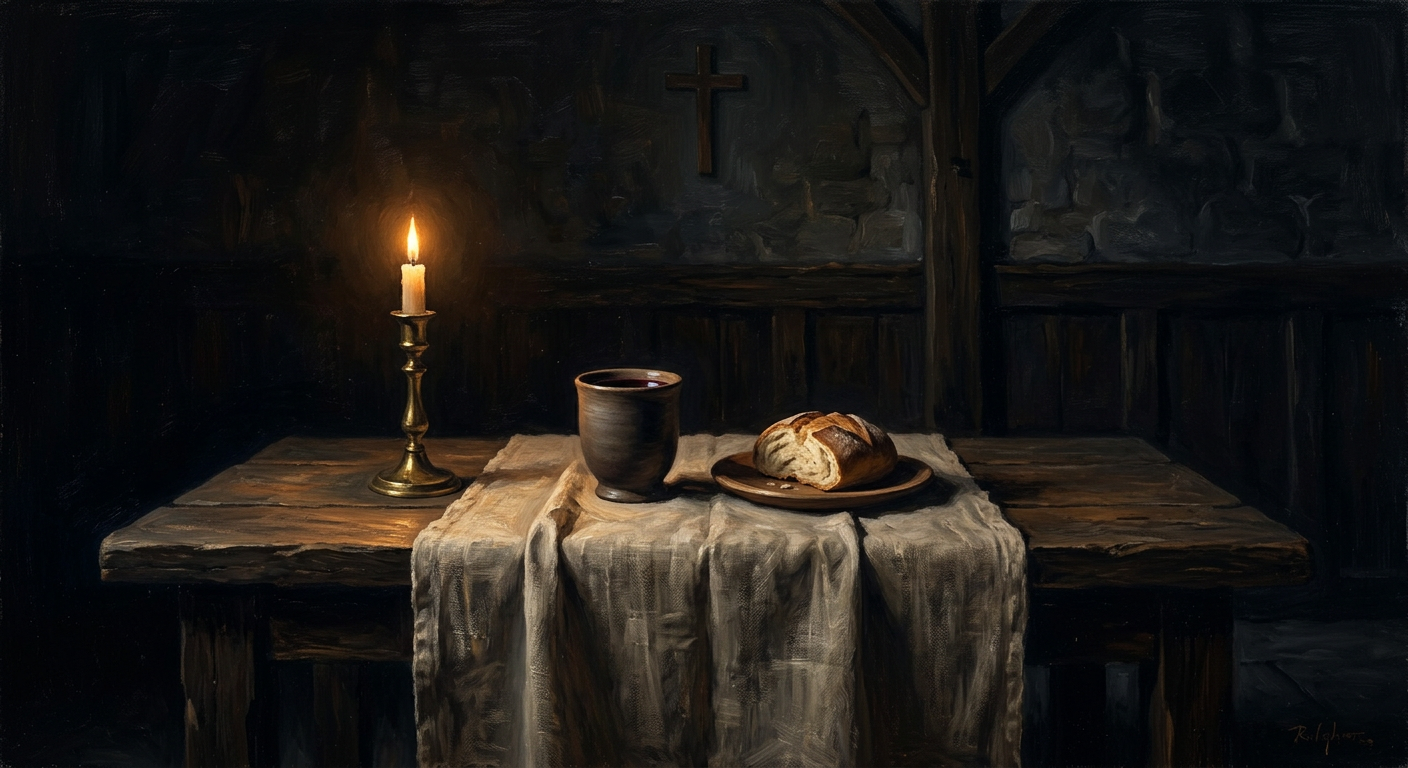
How Christ is present in the Lord's Supper split the Reformers from one another. Zwingli parted ways both with Rome's transubstantiation and with Luther's consubstantiation, the view that Christ's body is present in, with, and under the bread and wine. Zwingli's own position was the memorial view — a reasoned, symbolic reading of the sacrament. He insisted that the Spirit, being free, may work through the sacraments but is never bound to work through them alone. A sacrament, he taught, is a sign of grace already received, not a channel through which grace is conveyed.
What mattered to Zwingli was not the bread that saves but the Christ who gave himself on the cross for us; not the act of eating but the faith that lays hold of Christ. Bread and wine have no power in themselves to free the soul, and so the sacrament itself cannot be made a means of salvation. To hold that physically eating Christ's body produces faith or forgives sin was, in his judgment, idolatry in its purest form. For Zwingli, the Supper was a memorial feast, celebrated by believers who already possessed the assurance of faith.
In Closing
A humanist, a theologian, and the father of the Reformed tradition, Zwingli fell in battle at Kappel while still a young man. History gave him no years to refine his thought or leave behind a settled, systematic theology. Even so, he left the church a legacy worth more than any treatise: soli Deo gloria, to God alone be the glory. Zwingli placed Scripture at the very center of the Christian life and made it the wellspring of true piety.
If Luther's Reformation began in a personal wrestling for assurance of salvation, Zwingli's began in longing for the salvation of a people — his own beloved Switzerland. That difference points to something larger: the Word of God reforms not the church alone but society and public life as well. In this sense, Zwingli's Reformation anticipated what Abraham Kuyper would later formalize as sphere sovereignty. His life still puts the same question to us today. In every sphere entrusted to us, are we living out the lordship of God?
About Author

faith.log
A journal that connects faith and everyday life. In each small piece of writing, we share the grace of God and the depth of life together.


