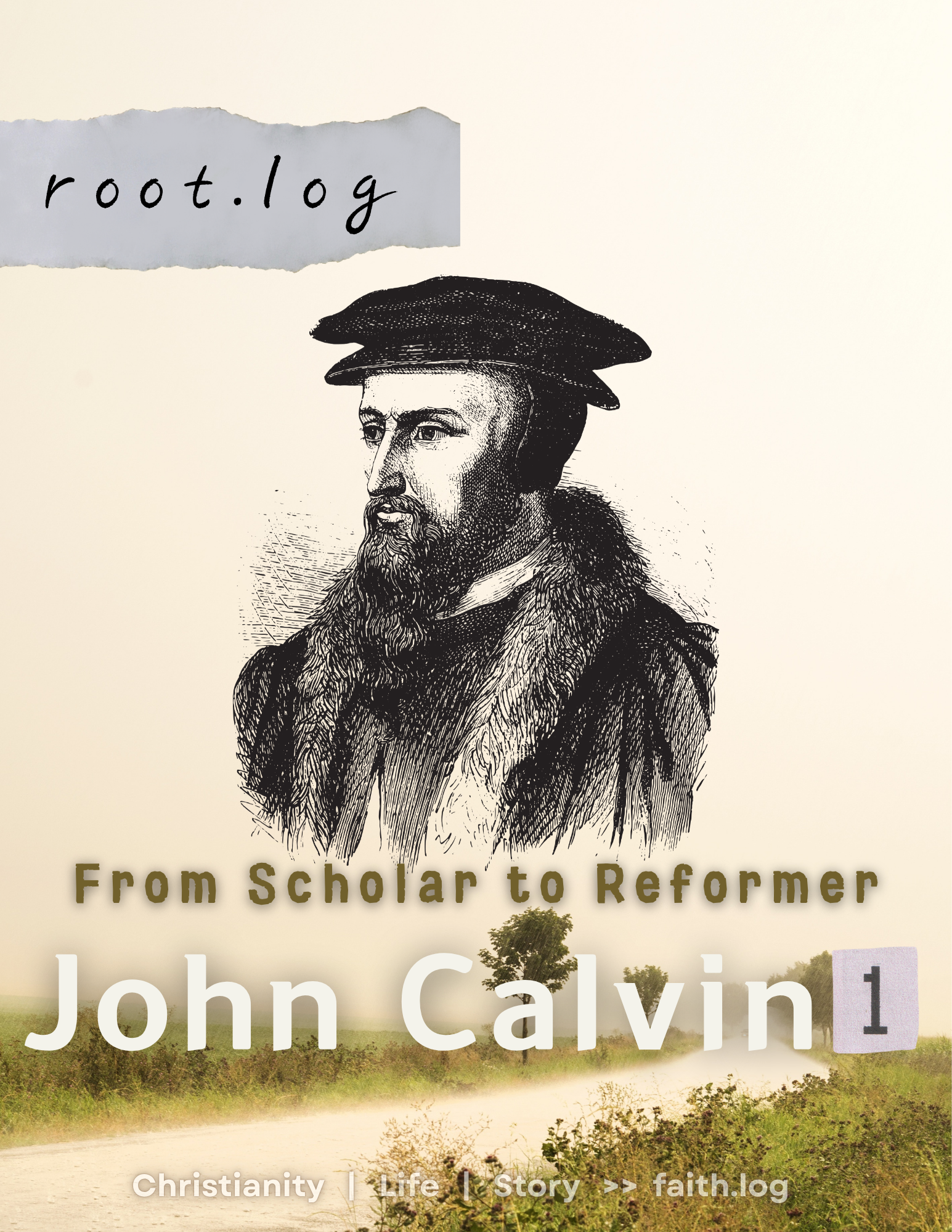
The Man Who Rooted the Reformed Faith: John Calvin, Part One — From Scholar to Reformer
History has given the church no shortage of reformers, each one summoned in his own way to call God's people back to the truth of Scripture. But ask who did more than anyone else to plant Reformed theology so deeply that it still holds its ground on Scripture alone, and one name comes to nearly everyone's lips: John Calvin. His theological and scholarly influence has not diminished with the centuries, and that fact alone tells us how much weight he carries in the Reformed tradition. This is the first of four installments on his life and thought.
Calvin's Boyhood Was Providence Quietly at Work

John Calvin was born on July 10, 1509, in Noyon, a town north of Paris, the fourth of six children. His father, Gérard Cauvin, was a self-made man who served as secretary to the bishop of Noyon and legal counsel to the cathedral chapter. His mother, Jeanne Lefranc, died in 1515, when Calvin was six. The elder Cauvin kept close ties with the noble family of Bishop Charles de Hangest, who governed Noyon, and through that connection young Calvin acquired something rare among the reformers: an early education in the manners of the upper class.
At twelve, through his father's arrangement, Calvin received a benefice at the altar of La Gésine in the Noyon cathedral, a kind of scholarship paid in exchange for assisting at Mass. That income carried him to the University of Paris in 1523, where he first studied at the Collège de la Marche under Mathurin Cordier, laying the groundwork for the Latin prose style he would later be known for. He then transferred to the Collège de Montaigu, a stronghold of Catholic orthodoxy, where the Scottish philosopher John Major trained him in Aristotelian logic and nominalism. He earned his master of arts in 1528.
His father had initially intended him for the priesthood, but after a falling-out with the cathedral chapter, he redirected his son toward law. Calvin studied under the renowned jurist Pierre de l'Estoile at the University of Orléans beginning in 1528, then moved to Bourges in 1529 to hear the lectures of the Italian jurist Andrea Alciato. There he fell under the spell of humanism, and after three years of study he took his law degree at Orléans in January 1532.
Writing as a humanist, Calvin published his first book on April 4, 1532: a commentary on Seneca's De Clementia. It reveals a mind of remarkable erudition and moral seriousness, but nothing more. The Calvin of these pages is a learned humanist with no particular interest in religious controversy.
On the surface, none of this looks like the makings of a reformer. But God was using these years to shape a man who would one day write the Institutes of the Christian Religion and leave a mark on the church that has not faded. Even then, providence was quietly forming Calvin for the theological and scholarly labor that lay ahead.
Two Events After His Conversion Pushed Calvin Toward Reform

In the preface to his commentary on the Psalms, the learned humanist confesses to a "sudden conversion." He never named the date, and scholars place it sometime between the spring of 1532, when his first book appeared, and the spring of 1534.
"God subdued my heart to teachableness by a sudden conversion.”
On November 1, 1533, the Feast of All Saints, Calvin's friend Nicolas Cop delivered his inaugural address as rector of the University of Paris at the Church of the Mathurins, calling for reform in language borrowed from Erasmus and Luther. Tradition has long held that Calvin wrote the address himself, but no firm evidence confirms his authorship. What is certain is that the speech provoked a furious response from the theologians of the Sorbonne, that the Parlement of Paris opened an investigation into Cop, and that Calvin himself was suspected as the author and threatened with arrest. He fled Paris and went into hiding.
Under the assumed name Charles d'Espeville, Calvin took refuge with his friend Louis du Tillet, a priest in Angoulême in southwestern France. There he began drafting the first edition of the Institutes. On May 4, 1534, he formally broke with Rome by resigning the benefice he had held since childhood.
That October 17–18, a second crisis shook France: the Affair of the Placards. Overnight, posters attacking the Catholic Mass appeared in Paris and several major provincial cities, one of them nailed to the bedroom door of King Francis I himself at the Château d'Amboise. The author is believed to have been Antoine Marcourt, and the placard's title left nothing to the imagination: "True Articles on the Horrible, Great, and Insufferable Abuses of the Papal Mass, Which Is Directly Opposed to the Holy Supper of Our Lord.”
Together, these two episodes brought persecution of French Protestants to a fever pitch. Calvin left France entirely and arrived in Basel the following January. There he finished the Institutes, writing on August 23, 1535, the preface addressed to King Francis I in defense of the persecuted reform movement. The book was published in Basel in March 1536. What began as six chapters of catechetical instruction would grow through repeated revisions into the monumental eighty-chapter work of the 1559 final edition.
Calvin's First Pastorate in Geneva Began in Hope and Ended in Exile

Calvin believed his calling was to scholarship and writing, not to public leadership. He hoped for a quiet life of biblical study, and after a brief stay in Ferrara, Italy, he set his sights on Strasbourg. But war between France and the Holy Roman Empire closed off the direct route, forcing him to pass through Geneva instead.
Geneva at the time had only one reformer of note, Guillaume Farel, a Frenchman laboring largely alone. When Farel learned that Calvin was passing through, he sought him out and pleaded with him to stay and help. Calvin refused, insisting he meant to continue his studies in Strasbourg. Farel would not accept no for an answer. Invoking Jonah, who fled his calling and was swallowed by the fish for it, Farel warned Calvin that God would curse his peace and his studies if he turned his back on so urgent a need. Calvin later recalled the moment:
"He proceeded to utter an imprecation, that God would curse my retirement and the tranquility of the studies which I sought, if I should withdraw and refuse to give assistance, when the necessity was so urgent. This imprecation struck me with such terror that I gave up the journey I had undertaken.”
Calvin gave in. In September 1536 he stood in the pulpit of St. Pierre in Geneva as a lecturer on Scripture. His presence was modest at first, but he soon outgrew Farel's shadow and began driving reform efforts of his own.
In January 1537, Calvin and Farel submitted a set of three proposals to the city's Small Council: monthly celebration of the Lord's Supper, adoption of a catechism Calvin had prepared, and a confession of faith to be sworn by every citizen. The council revised the proposals considerably but ultimately adopted them.
Resistance followed quickly. Under Calvin's principles, anyone who refused to make a confession of faith or who lived immorally was barred from the Lord's Table, and exclusion from the Table meant exclusion from citizenship and economic life alike. Noncompliance meant banishment from the city.
The council began pushing back. On January 4, 1538, it voted to overturn the ban on immoral citizens receiving communion. February elections brought in a wave of councilmen hostile to Calvin's reforms, and Jean Philippe, one of his fiercest opponents, was elected as syndic. The new council ordered that enforcement of church discipline pass from the ministers to city officials. Calvin, Farel, and the other pastors responded by refusing to administer communion on Easter Sunday. The city's General Council was convened and gave the two men three days to leave Geneva. Roughly eighteen months after his arrival, Calvin's first Genevan pastorate ended in failure.
Closing Reflection
This installment has followed Calvin from his boyhood to the collapse of his first ministry in Geneva. His work as a reformer was far from finished, but even here we can trace God's hand shaping him through every setback for the labor still to come. The providence that formed him as a scholar and a believer used even this failure as the foundation for what would follow. Our own lives are marked by seasons we cannot make sense of and failures that feel final, and Calvin's story reminds us that God uses every one of them to prepare us. It reminds us, too, that answering God's call requires nothing less than full obedience. The next installment picks up where this one leaves off, tracing Calvin's years in Strasbourg and his return to a second, more enduring ministry in Geneva.
About Author

faith.log
A journal that connects faith and everyday life. In each small piece of writing, we share the grace of God and the depth of life together.


