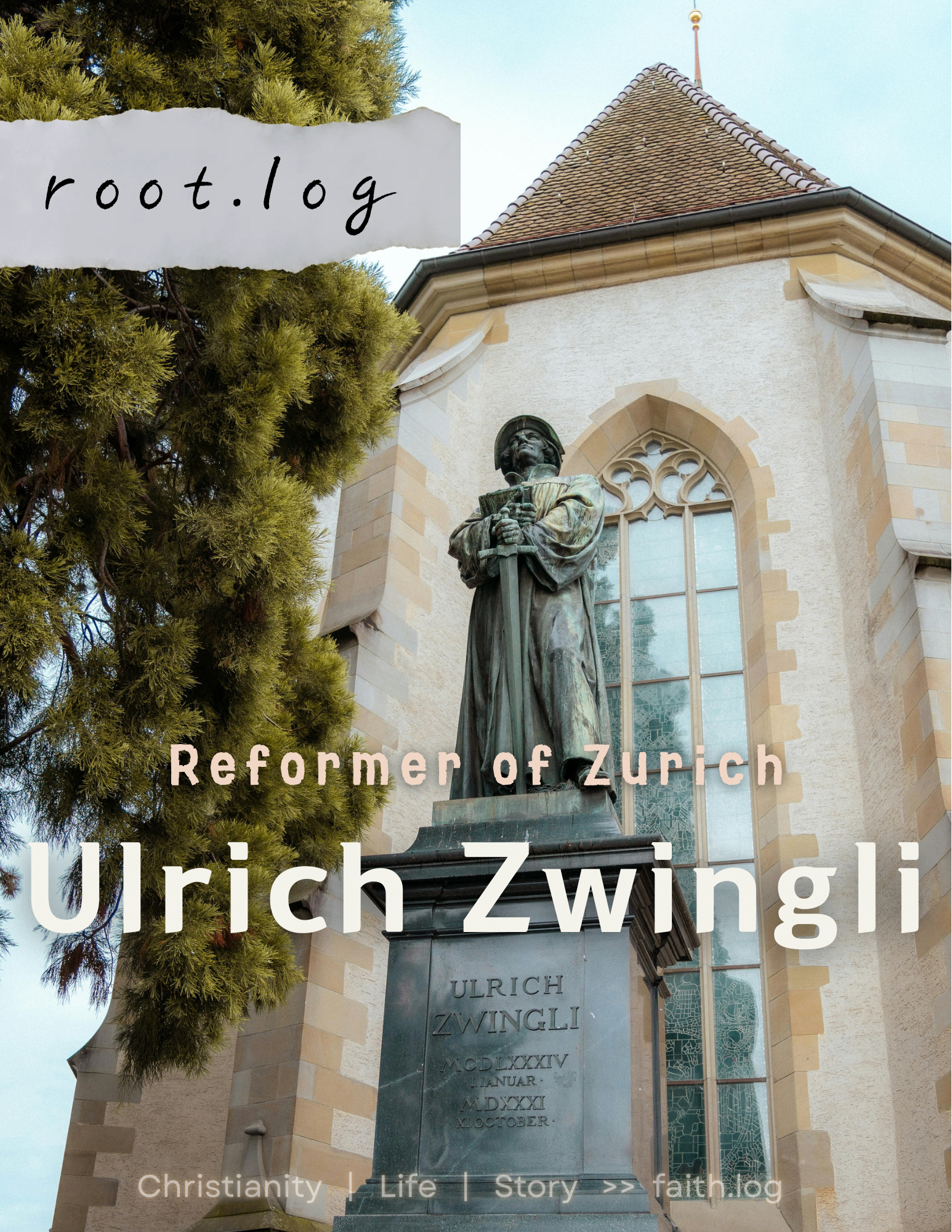
Reforming Church and Society Together: Ulrich Zwingli of Zurich
The root.log has been introducing figures from the history of the Reformation in successive installments. This entry turns to Ulrich Zwingli, the preeminent reformer of Zurich, Switzerland. In the early sixteenth century, humanist scholars immersed in classical literature and the writings of the early church fathers began to recognize with growing clarity that the church of their day had gone badly wrong. This recognition produced two distinct responses. Some — Erasmus being the most prominent — chose to work for reform from within the structures of the Roman Catholic Church. Others called for nothing less than a thoroughgoing transformation rooted in the spirit of the Reformation. Ulrich Zwingli belongs decisively to the second company. He took an entire city — Zurich — as his stage and set about reforming church and society simultaneously.
Formed in the Cradle of Humanism
Ulrich Zwingli was born on January 1, 1484, in Wildhaus, Switzerland, into a comfortable household; his father served as the village magistrate. From the age of six he received formal schooling, moving at ten to a Latin school in Basel and at twelve to Bern, where he studied under the humanist Heinrich Wölflin.
Between 1500 and 1502 he studied at the University of Vienna, where the humanist currents of the age led him to explore the nature of true freedom within the Christian faith. He then continued at the University of Basel — the first institution north of the Alps to embrace the Renaissance — earning a Bachelor of Arts in 1504 and a Master of Arts in 1506, after which he was appointed priest of the parish of Glarus. During a decade in that post he mastered Greek and Hebrew, immersed himself in the works of Erasmus, grew into a commanding preacher, and earned a respected place among the small circle of northern humanists.
In 1510, Zwingli made his first public foray into political affairs with "The Fable of the Ox," arguing that the Swiss Confederation should align itself steadfastly with the papacy. As a reward, the Pope granted him an annual pension of fifty gulden — equivalent, in today's terms, to roughly twenty-seven million Korean won.
The Battlefield That Broke Him Open
In 1513 and again in 1515, Zwingli accompanied young men from his region to fight as mercenaries at the Battle of Novara. The carnage he witnessed left him deeply disillusioned with the mercenary system, and he began to advocate for its abolition while nursing a passionate longing for peace.
The experience of war worked a fundamental transformation within him. Through Erasmus he came to understand the authority of Scripture and the right method of reading it, and he developed an ethic oriented toward a practical, lived Christianity. His convictions about peacemaking and preaching, along with a concrete vision for ecclesiastical reform, took shape during this period. Above all, his encounter with Erasmus's Greek New Testament of 1516 opened his eyes to Scripture in an altogether new way. Reading the apostolic church in its own words, he could not avoid the stark contrast between the life of those early congregations and the practices of Roman Catholicism in his own day.
On December 27, 1518, Zwingli received a call from the chapter of Zurich's Grossmünster church, and on January 1, 1519, he began his ministry there in earnest. By the time he arrived in Zurich, he had already reached theological conclusions closely parallel to Luther's — though the path had been quite different. Where Luther's reformation sprang from his anguished struggle over justification, Zwingli's convictions had been forged through rigorous humanist biblical scholarship, outrage at the superstition masquerading as Christianity in the churches of his day, indignation at the moral corruption of the clergy, and a deep opposition to the mercenary system. In Zurich he proclaimed the gospel, held up the purity of the apostolic community as the model for the church, and did not hesitate to name the moral failures of the priesthood and to challenge the cult of the saints.
The Plague, and the Parting of Ways with Humanism
In August 1518, plague swept through Zurich and the northern cantons of Switzerland. Zwingli ministered faithfully to the sick without flinching. He himself contracted the disease in September 1519 and spent nearly a year on the threshold of death before recovering. In 1520, his brother Andreas died of the same illness. Through this extended season of suffering, Zwingli experienced the grace and providence of God at a depth he had not known before, and renewed his commitment to give himself wholly to the reform of church and society. He renounced the papal pension.
From this point he also broke with the humanist program of reform. When the humanists argued that reform should proceed under the acknowledged authority of the pope, Zwingli declared that true authority belongs to Scripture alone. The difference was not one of temperament or strategy; it was a difference over the very foundation of authority. In the end, it separated him from the humanists decisively. This was his clear and costly commitment to what the Reformation would come to name Sola Scriptura.
The Affair of the Sausages: A Reformation Lit from the Table
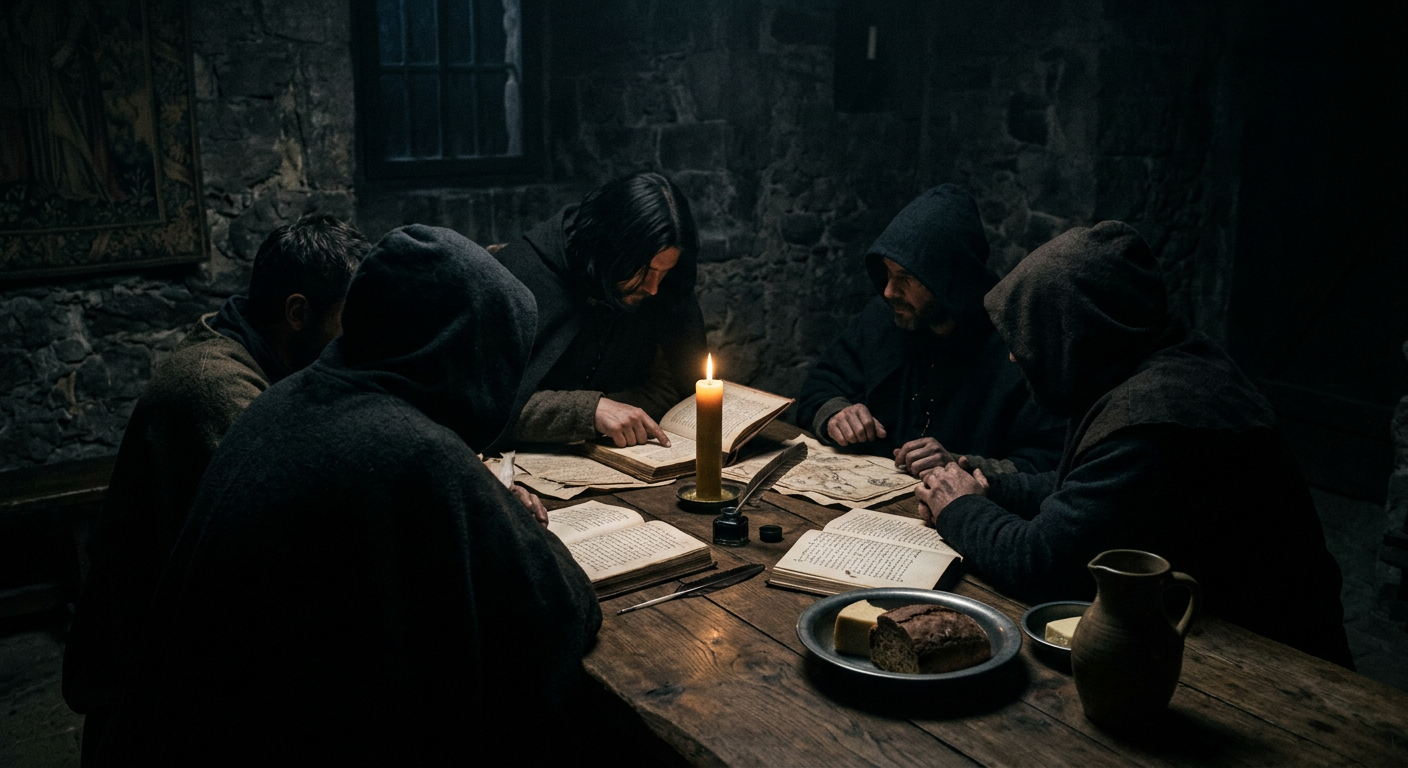
In 1522, Zwingli began pressing the reform of Zurich with new urgency. The spark came on the evening of March 9 — the first Sunday of Lent — in what history has come to remember as the Affair of the Sausages. Twelve leaders of the Grossmünster church had gathered at the home of the printer Christoph Froschauer to work on a German-language Swiss Bible. As the night wore on, sausages appeared on the table. Zwingli was present but, by all accounts, did not eat. Word of the incident spread rapidly, and the Bishop of Constance demanded that the Zurich city council arrest and imprison those who had eaten.
Zwingli responded not with silence but with Scripture. On March 23, the third Sunday of Lent, he preached on the question of fasting regulations, and on April 16, after Easter, he published the sermon under the title "On the Choice and Free Use of Foods." His argument was characteristically Reformed in structure: the question of whether eating meat during Lent constitutes sin must be determined by Scripture alone, and Scripture furnishes no grounds for such a verdict — and therefore no basis for punishment. Christians may eat meat during the fast if conscience permits, but they are to exercise that freedom with restraint, mindful of its effect on others and on the common good. The sermon and its published form became the fuse that ignited the Reformation in Zurich.
Reforming Zurich by the Authority of Scripture
On July 2, 1522, Zwingli and ten fellow priests submitted a public letter to the Bishop of Constance calling for freedom to preach the gospel and for the abolition of mandatory clerical celibacy. That same summer, while the Franciscan friar Lambert was delivering a traditional Catholic address on Mary and the saints at the Fraumünster church, Zwingli was sitting in the congregation. Unable to remain silent, he cried out: "Brother, you are wrong!" — and the gathering immediately became an open theological debate. On July 21, the city council directed all friars to preach henceforth according to Scripture alone, publicly vindicating Zwingli's position. In September of the same year, his sermon on the perpetual virginity of Mary mounted a direct challenge to Marian devotion.
As Zwingli's preaching and publications pressed the case for reform with increasing force, Zurich became a city divided. The council convened a public disputation on January 20, 1523. Zwingli prepared by condensing his reforming vision into sixty-seven theses, the now-famous Sixty-Seven Articles, in which he called for the recovery of a Christ-centered and Scripture-centered faith, declared Christ alone to be the head of the church, and defended the marriage of the clergy. That disputation marked the end of medieval Roman Catholicism in Zurich and the first gathering of a Reformed church.
A Reformer Who Died in the Field
As the reform movement spread outward from Zurich, Switzerland fractured along confessional lines. The northern cantons embraced Zwingli's theology; the mountain cantons remained loyal to Rome. The fracture made armed conflict all but inevitable. In June 1529, Zwingli led forces to Kappel and confronted the Catholic cantons, who agreed to cease their persecution of the Reformed and to leave the choice of religion to individual conscience.
The peace did not hold. On October 11, 1531, five Catholic cantons launched a combined assault on Kappel. Zwingli joined the advance force of some fifteen hundred men to buy time for Zurich's defenses, was struck by a lethal blow to the throat, and was taken prisoner. He died refusing the last rites from a Catholic confessor. His body was quartered and burned; the ashes were mixed with dung and scattered — Rome's deliberate effort to ensure that no Protestant relic could ever be gathered from what remained of him.
After Zwingli's sudden death, his disciple and successor Heinrich Bullinger assumed the pastorate of the Grossmünster and carried the Reformation forward. The monument standing at Kappel to this day bears the words attributed to Zwingli in his final moments:
"You may kill my body, but you cannot kill my soul.”
Every Square Inch Belongs to God
Zwingli's reformation confronts the contemporary Christian on more than one level. Human beings find it extraordinarily difficult to relinquish privilege — especially when that privilege was earned by doing what seemed, at the time, to be right. Zwingli returned an annual papal pension worth some twenty-seven million won and walked away from the social standing he had built among the humanists. What he chose instead was Scripture. His life testifies, without qualification, to what it costs to guard the purity of faith over material comfort and social position.
The Reformation was never merely an intellectual affair. Zwingli makes that inescapably clear. His reform reached beyond the church walls into society, into the state, into the texture of ordinary life. The theological debate surrounding his decision to take up arms is real and ought not be dismissed. But what cannot be disputed is his conviction that the claims of the gospel extend over every sphere of human existence. This is precisely the vision that Abraham Kuyper would later articulate in his doctrine of sphere sovereignty — that there is not a square inch in the whole domain of human existence over which Christ, who is sovereign over all, does not declare: Mine. Zwingli's enduring legacy is not a body of doctrine alone, but a summons: to bring every corner of the life we inhabit before God and under his Word.
About Author

faith.log
A journal that connects faith and everyday life. In each small piece of writing, we share the grace of God and the depth of life together.


