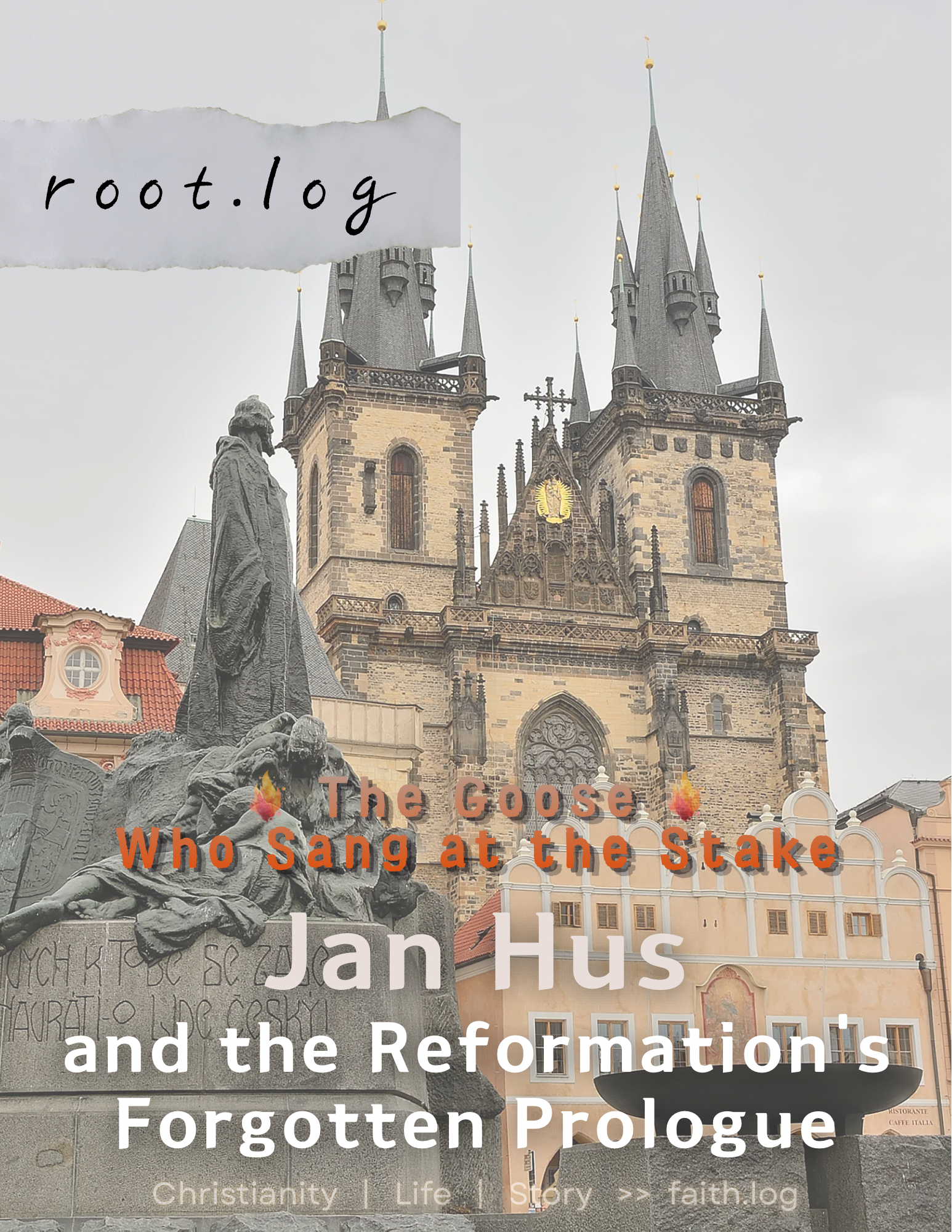
The Goose Who Sang at the Stake: Jan Hus and the Reformation's Forgotten Prologue
Church historians generally agree that the late medieval church reached its nadir of corruption in the century before Luther. What is less often acknowledged is that the fire Luther would set in Wittenberg had already been kindled—twice—before he was born. We examined the first of those sparks in an earlier root.log when we considered John Wycliffe. The second burned in a small nation most English-speaking Protestants could not find on a map: Bohemia. And it burned because one Czech priest, Jan Hus, carried Wycliffe's torch across the continent and into a fire of his own making at Constance.
Walk across the Charles Bridge in Prague today and you will pass a tower that once served as a grim open-air sermon from Rome. For a decade it displayed the severed heads of church leaders who had died for the cause of reform—a warning, in rotting flesh, to anyone who might consider preaching the gospel apart from papal sanction. That this same land produced one of the bravest pre-Reformation movements in Christendom, only to see it driven underground for two centuries, has conspired to keep Bohemia's story at the margins of Protestant memory. We treat it as a footnote because it "failed." But reform that is silenced by the sword is not failure; it is martyrdom, and the blood of martyrs has a longer memory than the politics that shed it. Luther himself would later say he had been "a Hussite without knowing it." We owe Bohemia better than a footnote.
Bohemia: Soil Prepared for Reform
The Bohemia Hus inherited was not a spiritual backwater. In the mid-fourteenth century, Emperor Charles IV—who was also king of Bohemia—had raised Prague to the dignity of an imperial capital and, in 1348, founded Central Europe's first university there. Charles University would become, in the following century, the intellectual nerve center of Czech reform.
Charles IV was also sympathetic to calls for ecclesiastical renewal, and under his protection a generation of preachers began to attack the worldliness of the church in the name of what they called simple gospel preaching. Their demands read like a rough draft of the program Luther and Calvin would later articulate with greater precision: reform of church and clergy, preaching in the vernacular, moral rigor among priests and laity alike, Scripture as the rule of Christian life, and frequent participation in the Lord's Supper. Into this native soil the writings of John Wycliffe were smuggled out of Oxford and across the empire, and the two streams converged. Bohemia became, almost overnight, the gravitational center of late medieval reform.
From Worldly Ambition to Awakened Faith
Hus himself was not born to this calling. He came into the world around 1371 in Husinec, a small village in southern Bohemia, the son of a peasant farmer. He later admitted without flinching that he had originally pursued the priesthood "to have a comfortable living and to be esteemed by men." His candor ought to unsettle every seminarian. The man who would be burned alive for the crown rights of Christ began his career chasing the same securities most of us quietly chase.
He entered Charles University around 1390, earning a bachelor's degree in arts in 1393 and a master's in 1396. By 1398 he was lecturing in the philosophy faculty while working toward the theological degrees he would complete in 1404. In those early years his mind was occupied chiefly with scholastic philosophy, not the evangelical calling that would consume him. Then he began reading Wycliffe, slowly at first, then seriously—incorporating the Englishman's philosophical works into his own lectures. And as he read, something else began happening. He began to see the church, and himself, in the light of the Scriptures he had until then treated as a professional text rather than a living word. The problem with the church, he came to see, was not at its margins but at its root: it had stopped listening to the Bible.
Years later he described the man he had been in a sentence that reads like every honest convert's confession:
"I gloried in my learning, in my splendid attire, in the games of chess I played, and in the banquets I attended with my companions.”
Between that sentence and the fire at Constance lies everything the gospel can do to a man.
The Pulpit at Bethlehem Chapel
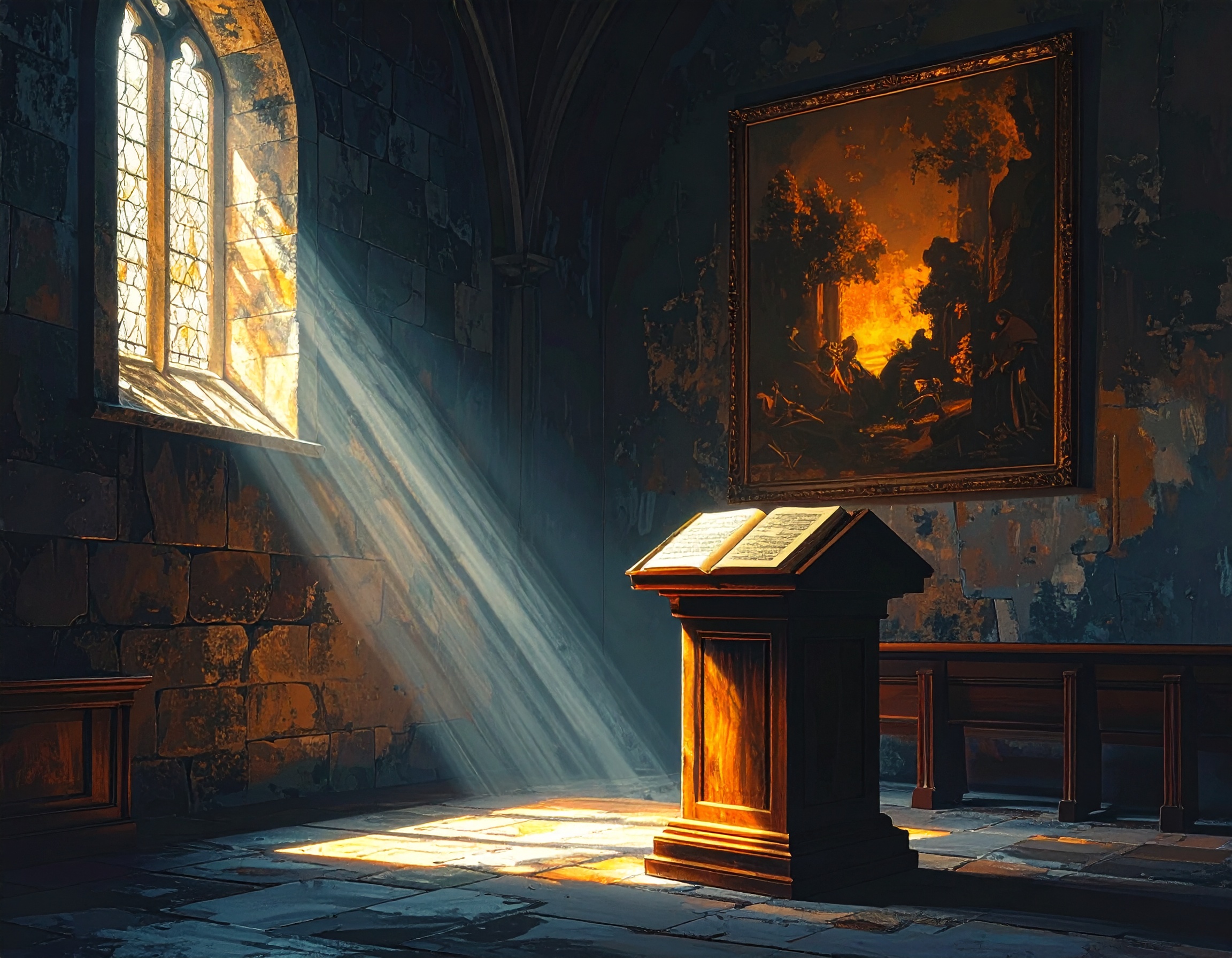
Hus was ordained in 1400 and began preaching the following year at St. Michael's in Prague. In 1402 he was appointed preacher at Bethlehem Chapel, a remarkable institution that had been founded specifically for preaching in the Czech vernacular. For twelve years he stood in that pulpit, and what he did there matters more than most of us realize.
He preached in Czech—plain, direct sentences that an unlettered artisan could follow. He composed hymns in the mother tongue, tuned to the cadence of the Bohemian soul, and taught his congregation to sing them together. Long before Luther translated Psalm 46 into German or Calvin shaped the Genevan Psalter, the ordinary people of Prague were singing Scripture in their own language, in their own voices, as an act of common worship. The Reformation's doctrine of the priesthood of all believers did not appear ex nihilo in 1517. It was already being practiced, hymn by hymn, a hundred years earlier in a single chapel in Prague.
From that same pulpit Hus demanded the reform of a church grown fat on worldliness and excoriated the greed and dissipation of the clergy. When he was sent to investigate the shrine at Wilsnack, which claimed to display bleeding eucharistic hosts, he returned convinced that the whole affair was a fraud—and said so publicly, forbidding pilgrimages there from the Bethlehem pulpit. He refused the commerce of relics not because he lacked reverence but because he had too much reverence to tolerate counterfeit holiness. This was the regulative instinct of the Reformation two centuries ahead of schedule.
Of course, he made enemies. His views, too closely resembling Wycliffe's already-condemned propositions, drew the fury of the German faculty at the university. Archbishop Zbyněk of Prague, eager to prove his loyalty to Pope Alexander V, turned against him. In 1410 Hus was forbidden to preach and ordered to surrender Wycliffe's books for burning. He did neither. With the king, many of the nobility, and most of the university behind him, he continued preaching from Bethlehem Chapel and defending Wycliffe's thought. In the Prague of those years, Hus was not merely a popular figure; he was a moral authority the ordinary people trusted more than their bishops.
The breaking point came in 1411–1412, when Pope John XXIII proclaimed a crusade against a rival claimant and his ally, the king of Naples, and promised plenary indulgences to anyone who would take up arms or pay into the papal war chest. Hus attacked the indulgence traffic with everything he had. Rome was not selling forgiveness, he insisted; it was counterfeiting the cross of Christ. For this he was excommunicated in 1413. And here a quieter tragedy unfolded: King Wenceslaus IV of Bohemia, who had protected Hus for years, had also been quietly collecting a cut of the indulgence revenues. A reformer who had once been useful had become inconvenient.
In November 1412 Hus withdrew into the countryside. The exile proved extraordinarily productive. He wrote tract after tract in Czech, exposing the corruption of popes and cardinals and archbishops without equivocation. And in 1413 he produced his masterwork, De Ecclesia—On the Church. In it he argued what Rome could not forgive: that the true church is not the visible hierarchy gathered around the pope, but the body of the praedestinati, the elect whom God has foreknown from eternity, and that the only Head of this church is Christ himself. Every confessional instinct a Reformed reader brings to that sentence—sola Scriptura, solus Christus, the church as the communion of the elect—was already taking shape in a Bohemian hermitage in 1413.
Constance: A Trial Sealed Before It Began

In late April 1414 Hus nailed—if the verb may be forgiven—a treatise called De sex erroribus, On the Six Errors, to the wall of Bethlehem Chapel. That document, together with De Ecclesia, gave his enemies the pretext they needed. The Council of Constance (1414–1418) summoned Hus on the stated grounds of investigating the relation between his teaching and the already-condemned doctrines of Wycliffe. His friends begged him not to go. They saw the trap. He saw it too, but he prepared his case with care and went anyway, believing he would at least be permitted to make his defense in open council.
He had, moreover, been granted a letter of safe conduct by the Emperor Sigismund himself, who had convened the council and guaranteed his freedom of movement and of speech. Hus believed the emperor's word. Pope John XXIII did not. "The church," he told Sigismund, "owes no faith to a heretic," and he pressured the emperor to revoke the guarantee. Three weeks after Hus arrived in Constance, on November 28, 1414, he was seized and thrown into the dungeon of a Dominican monastery. He would never walk free again.
His final hearing was held on July 6, 1415. He was given no meaningful opportunity to defend himself or to engage the theological questions at stake. Instead the council read out more than forty charges, many drawn from writings he had never written, and condemned him on the grounds that he had "adopted, defended, and preached" the opinions of Wycliffe as articles of faith.
When the hour came, they stripped him of his priestly vestments and placed on his head a paper miter painted with demons, inscribed with the words "Arch-heretic." Bound to the stake, he was offered one last chance to recant. He refused, and he prayed:
"Lord Jesus, forgive my enemies. Thou knowest the false witness they have borne against me and the unjust charges they have brought. In thy boundless mercy, forgive them.”
When the flames caught the wood beneath him, he cried, "Lord, have mercy," and began to sing. He sang until the smoke took his voice. On July 6, 1415, at the stake in Constance, Jan Hus died under the name of heretic and, I have no doubt, under the gaze of a Savior who recognized his own.
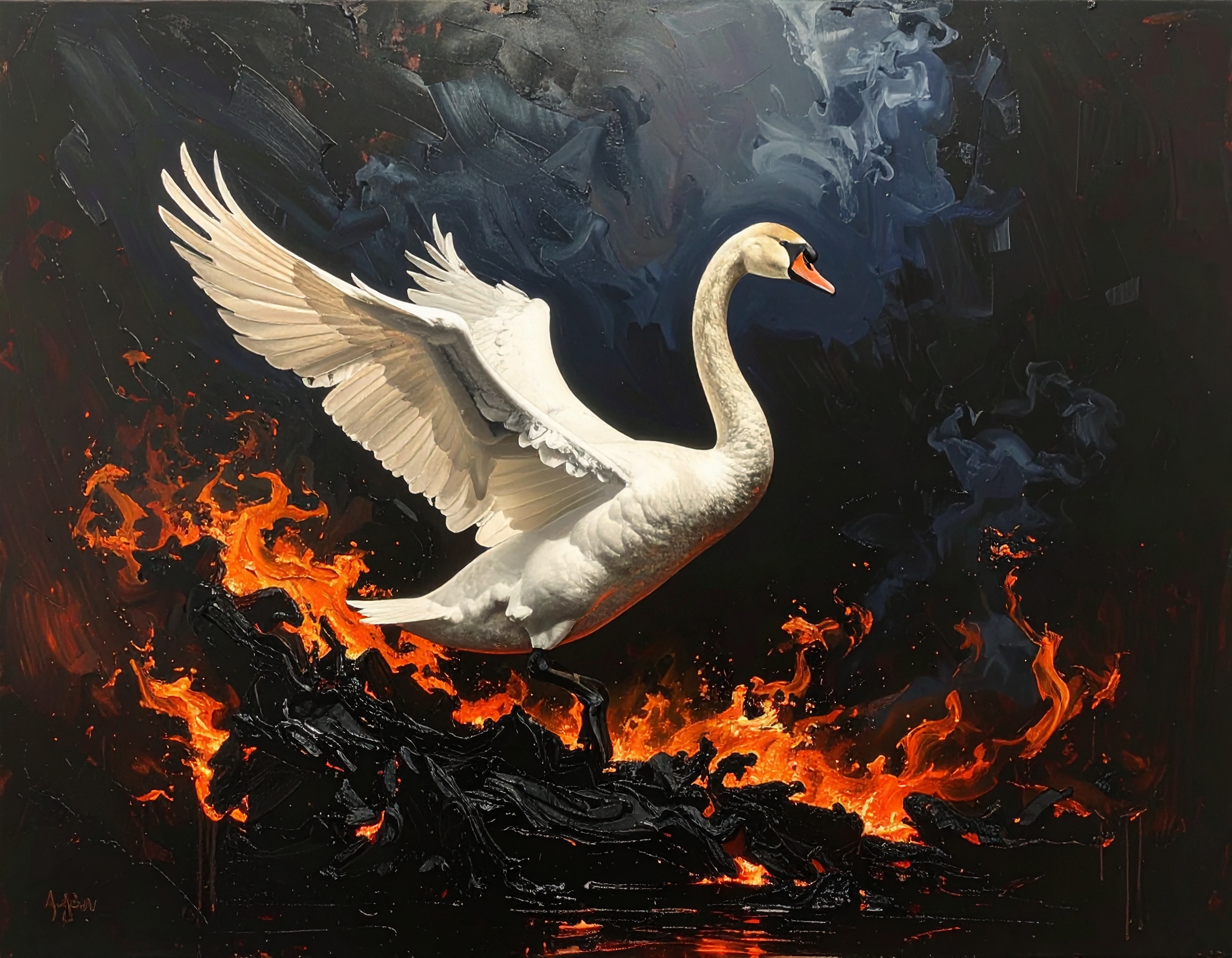
A Czech tradition holds that the condemned called out from the flames a prophecy his name made irresistible: Hus is the Czech word for goose. "You may roast this goose," he is said to have warned, "but from my ashes a swan shall arise whom you will not silence." A century later, Luther would seize on those words and make them his own. Whether or not Hus actually spoke them, the spiritual logic of the sentence is unimpeachable. The fire at Constance did not end the Reformation. It only confirmed it.
What the Goose Still Asks of Us

Six hundred years on, the death of Jan Hus still preaches. Watch him at the stake and you will see a pattern you have seen before: a man praying for his executioners, committing his spirit to his Master, singing as the fire rises. It is the pattern of Calvary, and the pattern of Stephen before the Sanhedrin. This is what a faith that has conquered death looks like when it is asked to walk out into the fire.
None of us is being asked, at present, to die for the name of Christ. And yet the ease with which we put that name down is harder to explain than Hus's refusal to recant. A promotion, a relationship, a little social discomfort, a passing fashion in the wider culture—and the name we were baptized into is set aside without resistance, as if it had never cost anyone anything. I return, in such moments, to the goose who sang at the stake. I let him ask me what he ought to ask all of us. Is the Christ for whom he would not stop preaching the same Christ I will not mention at a dinner table? Is the Scripture for which he walked to Constance the same Scripture I cannot be bothered to open on a Tuesday? Is the church whose true head is Christ alone the church I am willing to inconvenience my week for?
Sola Scriptura. Solus Christus. Coram Deo. Jan Hus did not coin those phrases. But he lived them and sang them into the smoke above Constance, and he did it a full century before the movement we call the Reformation knew what to call itself. May the church that bears his inheritance refuse to let his song die with him.
About Author

faith.log
A journal that connects faith and everyday life. In each small piece of writing, we share the grace of God and the depth of life together.


