

There are aspects of Korean church culture that settle into the background so gradually, you barely notice them — until one day you do. Lent was one of those moments for me.
The church I attend holds to the confessional standards of the Reformed tradition, so Lent was never front and center. Yet as Easter approached each year, the observance of Holy Week had long been a settled fixture of congregational life. And in recent years, I began to notice something: the language of Lent itself — not just Holy Week, but the full forty-day season — was quietly making its way into conversations and church calendars that once would have had no place for it.
The moment that sharpened my attention came during research for Easter content a year ago. As I searched for substantive material on Lent, I found that nearly all of it was being produced by Roman Catholic organizations. For Christmas, Thanksgiving, and Easter, Reformed publishers and ministries generate a steady stream of resources. But Lent? The field was almost entirely Catholic. That asymmetry demanded an explanation. And so I went back to the Reformers and to Scripture.
Calvin's Case Against Lent

What I found was unambiguous. The magisterial Reformers — particularly those standing in the Reformed and Presbyterian tradition — were unanimous in their critique of Lent. Calvin states his position plainly in the Institutes of the Christian Religion, Book IV, Chapter 12, Section 20:
"Then the superstitious observance of Lent had everywhere prevailed: for both the vulgar imagined that they thereby perform some excellent service to God, and pastors commended it as a holy imitation of Christ.”
Calvin's indictment is direct: Lent is a superstition. In Book II, Chapter 8, where he treats the Ten Commandments and the nature of worship, he presses home the danger of inserting humanly devised practices into the service of God. And in Book IV, Chapter 10, he turns his attention specifically to the problem of ecclesiastical traditions that lack scriptural warrant, warning that such traditions — however well-intentioned — cannot lead to salvation and will inevitably mislead the faithful. The parallel he draws is pointed: this is precisely what the Pharisees and scribes did when they burdened the people with traditions of their own making.
"In regard to things indifferent, we are not to impose anything on the consciences of believers as a matter of obligation.”
His treatment of Lent in IV.12.20 follows directly from these principles. Christ's forty-day fast, Calvin argues, was not an example set for believers to imitate annually. It was a singular, unrepeatable act — a sign that his teaching came not from men but from God. Christ fasted once, never again, and instituted no festival around it. The contrast with the Lord's Supper, treated in Book IV, Chapter 17, is telling: the Supper was explicitly instituted by Christ and expressly commanded to be observed. Lent was not.
The Reformers Speak with One Voice
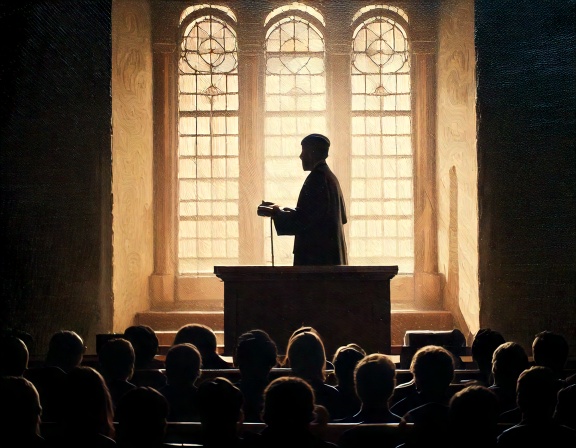
Calvin was not alone. Consider Zwingli. On the first Sunday of Lent in 1522 — March 9 — a gathering of twelve men in the Zurich workshop of printer Christoph Froschauer deliberately broke the Lenten fast by sharing smoked sausages. Zwingli was present, though he did not eat. What followed was a sermon he delivered in public defense of the gathering, a sermon that history has remembered as the opening salvo of the Swiss Reformation — the so-called Affair of the Sausages.
In that sermon, Zwingli declared that the observance of Lent was simply incompatible with the gospel, grounding his argument in Acts 10 and Colossians 2:16. No church authority, he insisted, has the right to impose fasting as a binding obligation on the Christian conscience.
"I do not forbid anyone to fast. I only insist that no one be compelled to do so.”
John Knox took the same ground in Scotland, applying the regulative principle with characteristic rigor. Operating under the conviction that worship must contain only what Scripture explicitly prescribes, Knox removed Christmas, Easter, and Trinity Sunday from the Scottish church calendar. The fact that Christmas was not widely observed in Scotland until relatively modern times is a striking reminder of how seriously Knox took this principle. He summarized it memorably:
"Disobedience to God's voice is not only when man goes wickedly contrary to the precepts of God, but also when of good zeal, or good intent, man does anything to the honour or service of God not commanded by the express Word of God.”
These convictions found their most authoritative corporate expression in the Westminster Assembly's Directory for the Public Worship of God (1645), a document the Reformed churches hold in common:
"There is no day commanded in Scripture to be kept holy under the Gospel but the Lord's Day, which is the Christian Sabbath. Festival days, vulgarly called Holy-days, having no warrant in the Word of God, are not to be continued.”
The State of Reformed Churches Today

When you examine how the Reformed world actually lives out these convictions today, a striking contrast emerges — particularly between Western Reformed churches and their Korean counterparts.
The Orthodox Presbyterian Church (OPC), the Reformed Presbyterian Church of North America (RPCNA), the United Reformed Churches in North America (URCNA), the Canadian Reformed Churches, and the Free Reformed Churches of the Netherlands do not observe Lent. Period. The Presbyterian Church in America (PCA), which occupies a somewhat broader evangelical space within the Reformed family, has no denominational directive on the matter, but its traditional practice has likewise been non-observance, with a degree of individual congregational variation in more recent years.
The situation in Korea tells a different story. The Presbyterian Church of Korea (Tonghap) and the Korean Christian Presbyterian Church have formally incorporated Ash Wednesday and the first Sunday of Lent into their official church calendars — a development that traces directly to their participation in the WCC ecumenical movement. That is a significant fact. The adoption of Lent in these bodies did not arise from a fresh reading of Scripture; it arrived as part of a broader ecumenical accommodation. The Presbyterian Church in Korea (Hapdong) — the denomination to which I belong — has not formally adopted Lent, but has largely left the matter to individual congregations, which amounts to a quiet acquiescence. Only the Kosin and Hapsin denominations have maintained a consistent Reformed resistance to its observance.
The gap between what the Reformers taught, what the Western Reformed churches practice, and what Korean Reformed churches are increasingly doing is not a small one. It is worth sitting with that gap honestly.
What Posture Should We Take?

Why, then, are Korean Reformed churches moving in this direction? The honest answer has little to do with Scripture. The currents driving this shift are the same currents that have long shaped Korean church culture: a pull toward visible programs, measurable spiritual seasons, and practices that lend structure to congregational life. In other words, the same impulse that drove the medieval Catholic church to institutionalize Lent in the first place.
There is something the Reformers understood that we need to recover: the corruption of worship rarely announces itself. It arrives through small accommodations, each of which seems reasonable on its own terms. The purity of the gospel is not guarded in a single dramatic stand but in a hundred quiet decisions to hold the line where Scripture draws it.
On the positive side, the Reformed tradition offers something richer than Lent: the Lord's Day. Every Sunday is a resurrection Sunday. Every Lord's Supper is a proclamation of Christ's death until he comes. The weekly rhythm of gathered worship — Word, sacrament, prayer — is itself a comprehensive memorial of everything Lent claims to prepare us for. We do not need a forty-day season to arrive at Easter. We are already living in the age of resurrection.
I want to close with a word from Prof. Seung-Goo Lee of the Hapdong Theological Seminary, from his essay On the Lent Abolished by the Reformers:
"We must live all of our time always 'in the light of the cross and resurrection of Christ.’"
That is the Reformed vision of the Christian life. Not a liturgical calendar that parcels out the mysteries of redemption into seasons and observances, but a life wholly offered to God — every day, every week, in ordinary time and in the gathering of the saints on the Lord's Day. That is the posture worth recovering.
<References>
John Calvin. Institutes of the Christian Religion, Books II.8; IV.10; IV.12; IV.17. Trans. Ford Lewis Battles. Westminster John Knox Press, 1960.
Westminster Assembly. The Directory for the Public Worship of God. 1645.
Seung-Goo Lee. "On the Lent Abolished by the Reformers." Bareun Mideum. 2017. https://www.good-faith.net/news/articleView.html?idxno=822
About Author

faith.log
A journal that connects faith and everyday life. In each small piece of writing, we share the grace of God and the depth of life together.


