When most people think about traveling to Jeju Island, their minds go straight to the usual itinerary: renowned restaurants, aesthetically curated cafés, scenic natural landmarks, and theme parks. That's understandable — Jeju is genuinely beautiful, and there's no shortage of things to see and do. But for those of us who travel as Christians, Jeju holds something far more profound than its tourist brochures suggest. This edition of step.log is an invitation to see Jeju through a different lens — one shaped by the gospel, by martyrdom, and by the quiet persistence of a faith that took root in some of the most unlikely soil imaginable.
Many of the places I'll introduce are located along the Jeju Pilgrimage Trail (Jeju Sunnyegil), and I'd encourage you to make that trail the backbone of your itinerary.
Along the Path Where the Gospel Took Root — The Jeju Pilgrimage Trail
The Jeju Pilgrimage Trail is a walking route designed for meditation and reflection — a path that follows the tracks of the gospel as it was carried across what was once one of Korea's most isolated and inhospitable regions. In 2025, a walking event was held along the trail, drawing participants eager to walk in the footsteps of those who came before. The trail is divided into five courses, each named for a distinct dimension of the Christian life.
Course 1: The Path of Obedience begins at Geumseong Church in Aewol. Walking this route, you encounter the story of independence activist Jo Bong-ho, a man whose Christian convictions animated his resistance to colonial rule. You'll also visit the childhood home of Pastor Lee Do-jong — the first Jeju-born ordained minister — who was later martyred during the tragic April 3rd Incident of 1948.
Course 2: The Path of Martyrdom begins at Hyeopjae Church, where Pastor Lee Do-jong served as a young man, and winds through Josoo Church before passing through the oreum (volcanic cones) and gotjawal (Jeju's unique forested lava fields). The landscape itself is ancient and wild, and the journey ends at the very site where Pastor Lee was killed — a sobering place that confronts you with questions you can't easily walk away from.
Course 3: The Path of Calling departs from Josoo Church, passes over Suwolbong Peak, and follows the shoreline at sunset. Along the way, you'll encounter the story of Pastor Jo Nam-su, who worked to protect the residents of Daejeong during the brutal violence of the April 3rd Incident. It is a quiet but powerful reminder of what the church can be when it refuses to look away from the suffering around it.
Course 4: The Path of Reconciliation begins at Pastor Lee Do-jong's martyrdom site and passes through churches that were established during the Korean War and small rural congregations that gave themselves in service to their communities. For those of us shaped by Reformed theology — with its insistence that faith must engage and transform every sphere of life — this course offers rich material for reflection.
Course 5: The Path of First Grace retraces the steps of Pastor Lee Gi-pung, who arrived at Sanjipo on Jeju Island in 1908 as one of Korea's earliest Protestant missionaries. This is the origin story of Jeju Christianity — and walking it means meeting the island's first elders, Kim Jae-won and Hong Sun-heung, men whose names most visitors have never heard but whose faithfulness shaped everything that followed.
Entering Through the Narrow Gate — The Pilgrim's Church
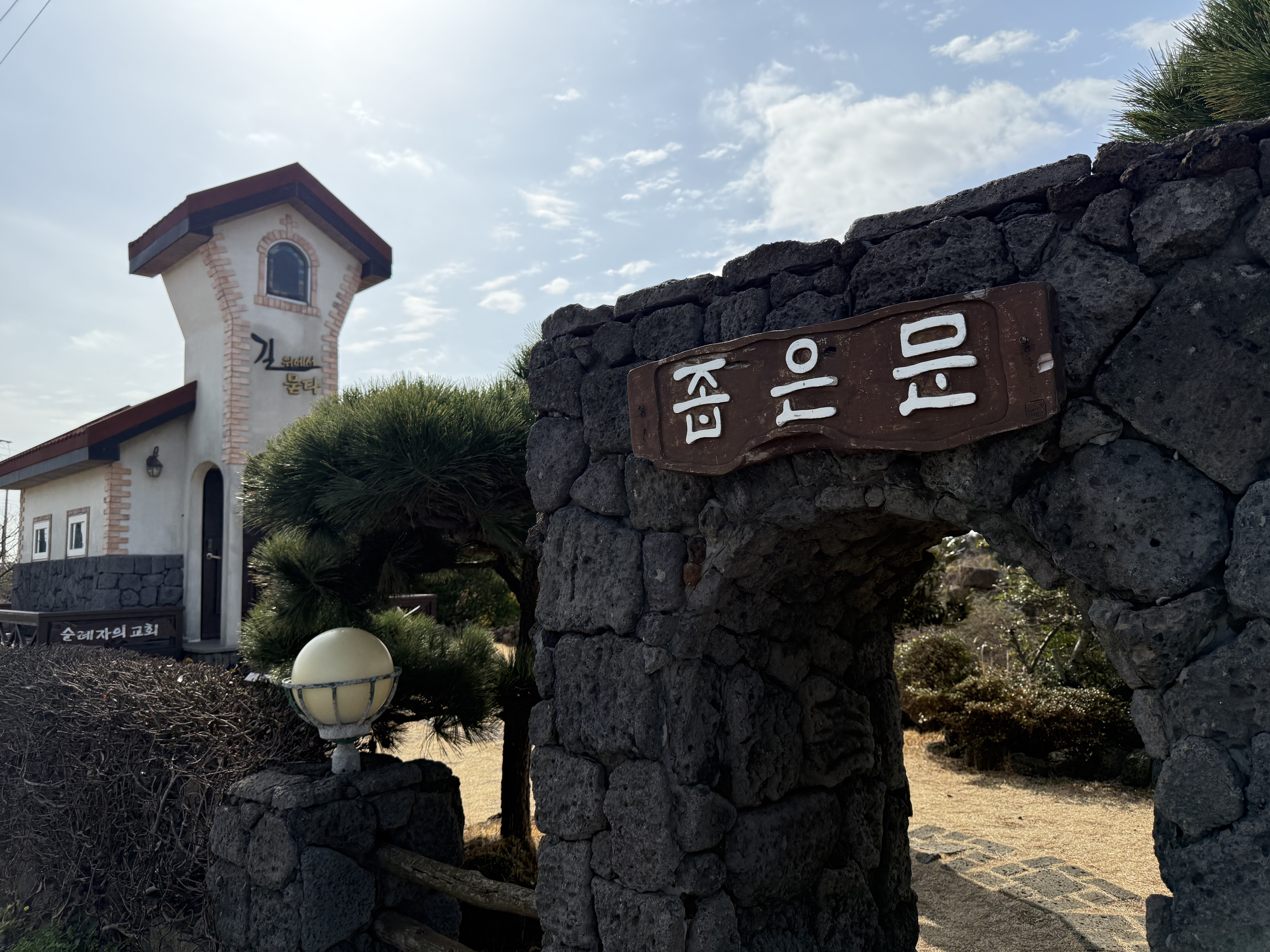
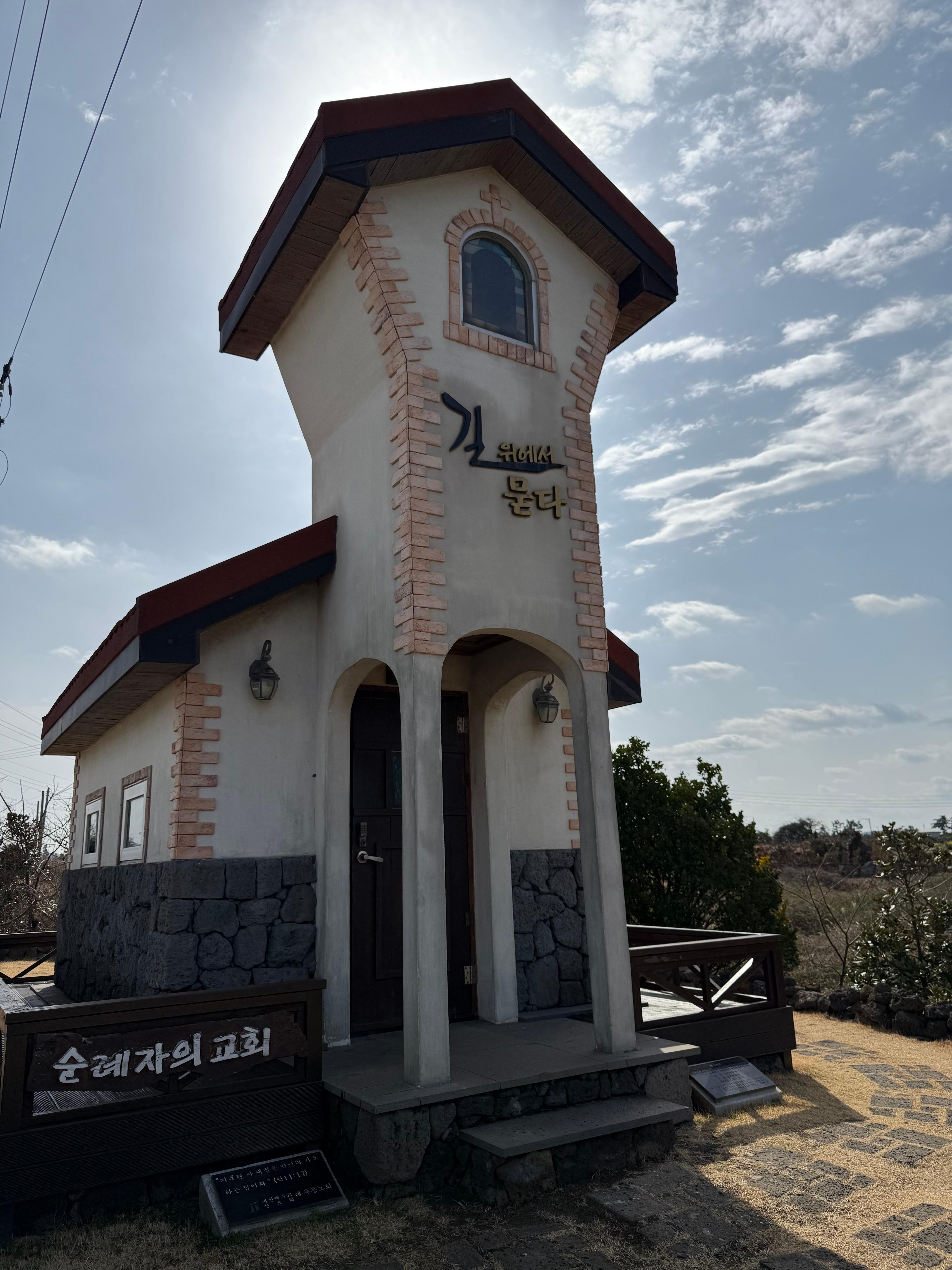
The Pilgrim's Church(Sunnyeja-ui Gyohoe) sits along Course 3 of the Jeju Pilgrimage Trail, at a point that overlaps with Jeju Olle Trail Route 13. It's easily accessible by car or on foot, and if you're driving, there's a generous open lot just before you arrive.
This church is billed as the smallest church in the world — and standing before it, that claim is entirely believable. According to the founding statement, it was built to embody a simple question: What does it actually mean to be a church? The builders wanted to capture the characteristics of Jesus' life as depicted in the Gospels, and they concluded that smallness, not grandeur, was the more faithful answer.
You enter through a narrow gate — and I mean that literally. In that single physical act, something stirs. For those of us who have grown up in an era of megachurches, multi-campus productions, and ministry-as-brand, walking through that gate has a way of asking uncomfortable questions before you've even stepped inside.
Behind the sanctuary, a wooden cross stands atop a foundation of dark volcanic basalt. It is stark and unadorned. It looks, honestly, like it belongs on a hill outside Jerusalem. Inside, the space holds perhaps three or four people comfortably — there's a guitar in the corner, just in case a small group wants to sing together.
The detail that stayed with me most: when you're seated inside, you can see the cross through the window. Turn off the lights, and it becomes even clearer — more defined, more present. I don't think that was accidental. There is a theology built into that design. When we strip away the noise and the ornamentation, when we quiet the relentless busyness that defines modern life, we see the cross more clearly. Calvin would have appreciated it.
A Church Built on a Martyr's Blood — Daejeong Presbyterian Church
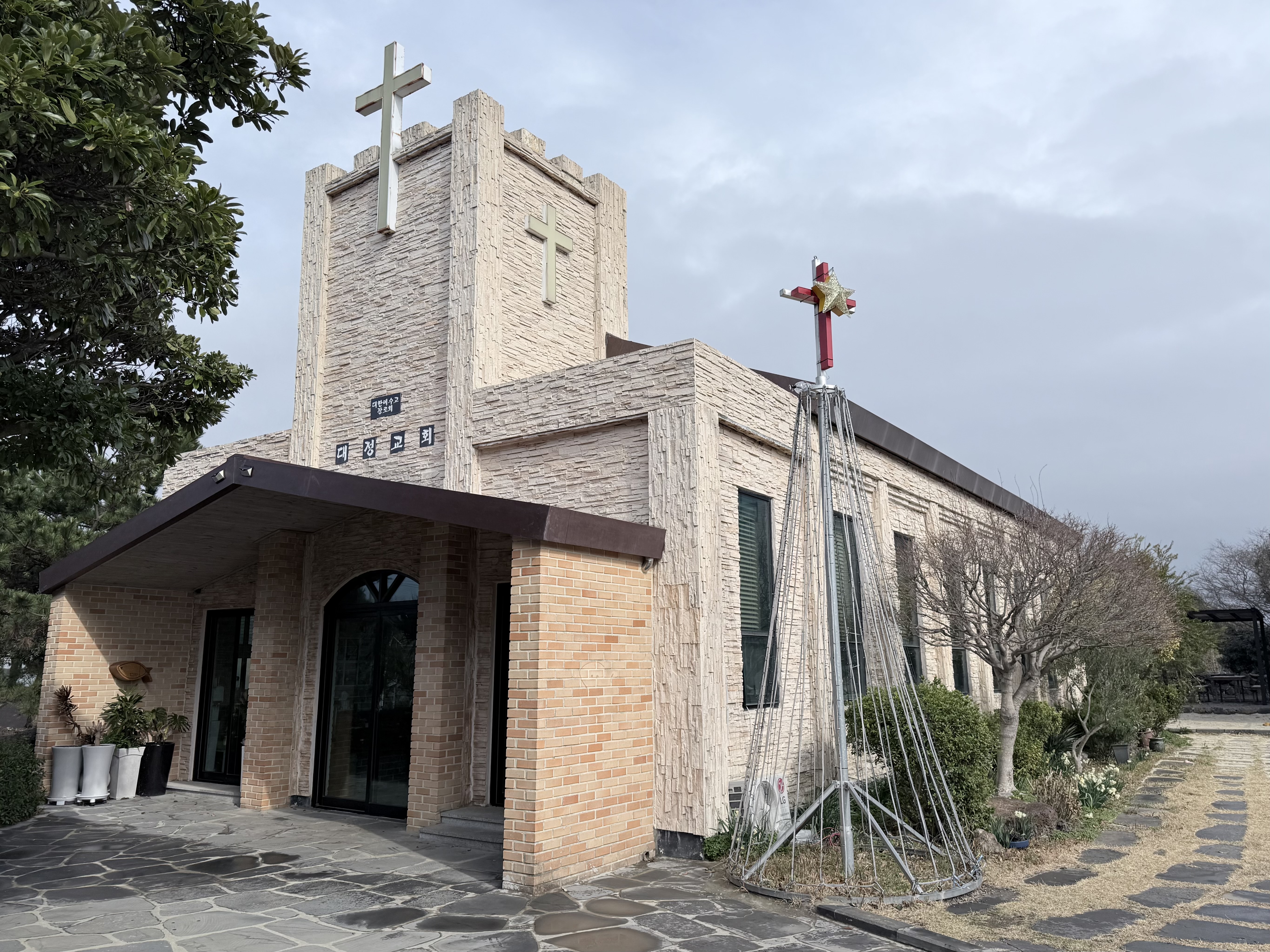
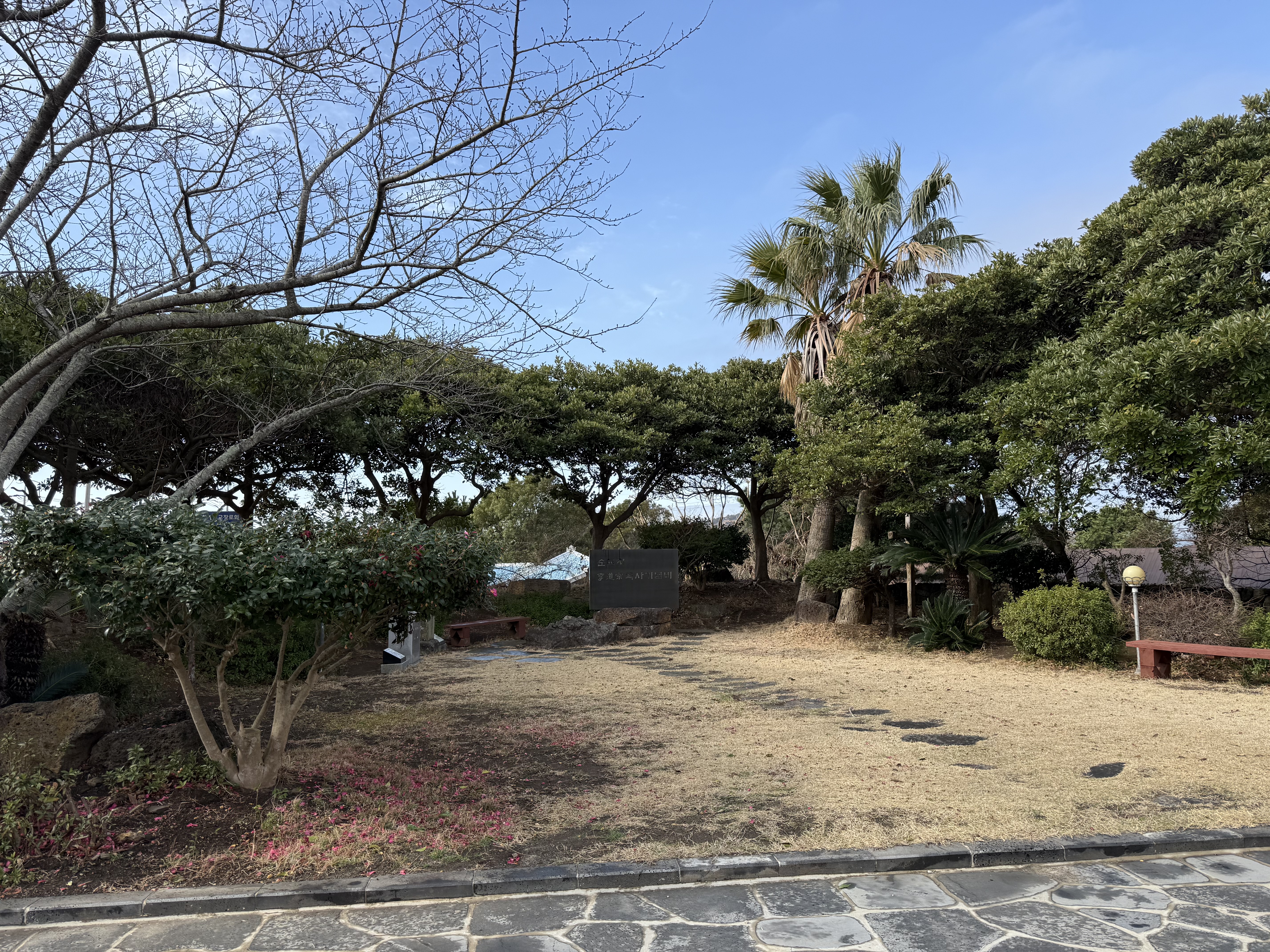
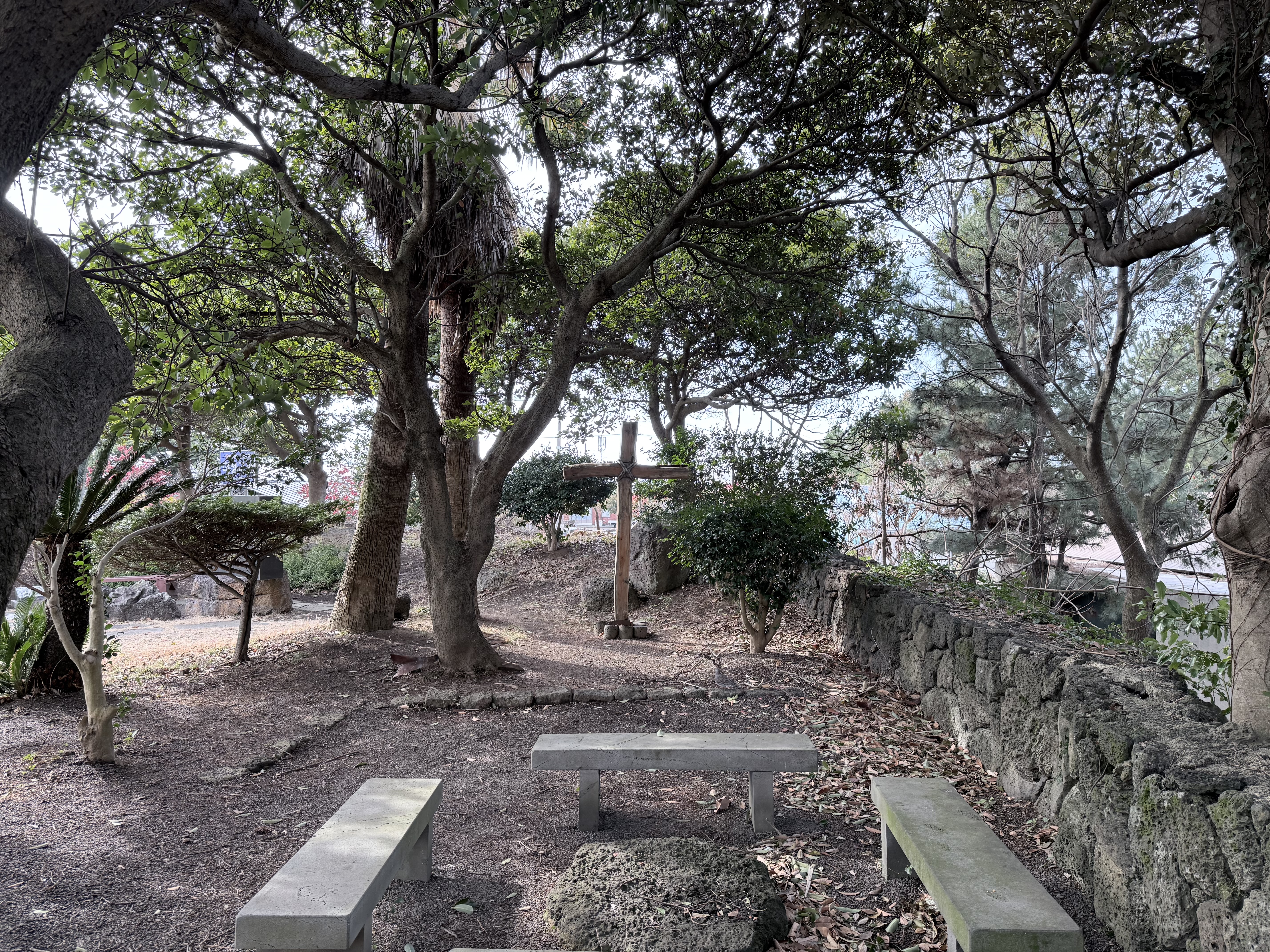
Daejeong Presbyterian Church lies along Course 4, the Path of Reconciliation. Its significance is inseparable from the life and death of Pastor Lee Do-jong, whose journey through this column has now come full circle. This was the last church he served. During the chaos of the April 3rd Incident, when it would have been entirely reasonable — arguably prudent — to stay home, he reportedly said, "If I don't go, who will lead my congregation in worship?" He set out for the church. He did not make it back.
For those arriving by car, a practical note: the nearby Jeju Chusa Museum — dedicated to Kim Jeong-hui, the celebrated Joseon-era scholar and calligrapher — shares its parking lot with the church. Follow the stone steps beside the restroom building in the museum's lot, and you'll find yourself at Daejeong Presbyterian Church without any trouble.
In the courtyard, you'll encounter a memorial stele and an ossuary monument honoring Pastor Lee. The stele, carved from stone quarried at Sanbangsan Mountain, is particularly striking. Most of Jeju's volcanic rock is porous basalt — riddled with holes — and so the congregation sent people all the way to Sanbangsan to find solid stone suitable for carving. The inscription was cut by hand. That effort alone tells you something about what this man meant to his people.
Standing before that stone, I found myself doing what I suspect most visitors do: measuring my own faith against his. It is not a comfortable exercise. But it is a necessary one.
The sanctuary is open to the public at all times. Whether you're walking the pilgrimage trail or making Daejeong Church your specific destination, this is a place to stop, sit, and pray. There is a particular weight to prayer offered in a church that exists because someone died to keep it open.
A Church That Speaks of Refuge — Bangju Church
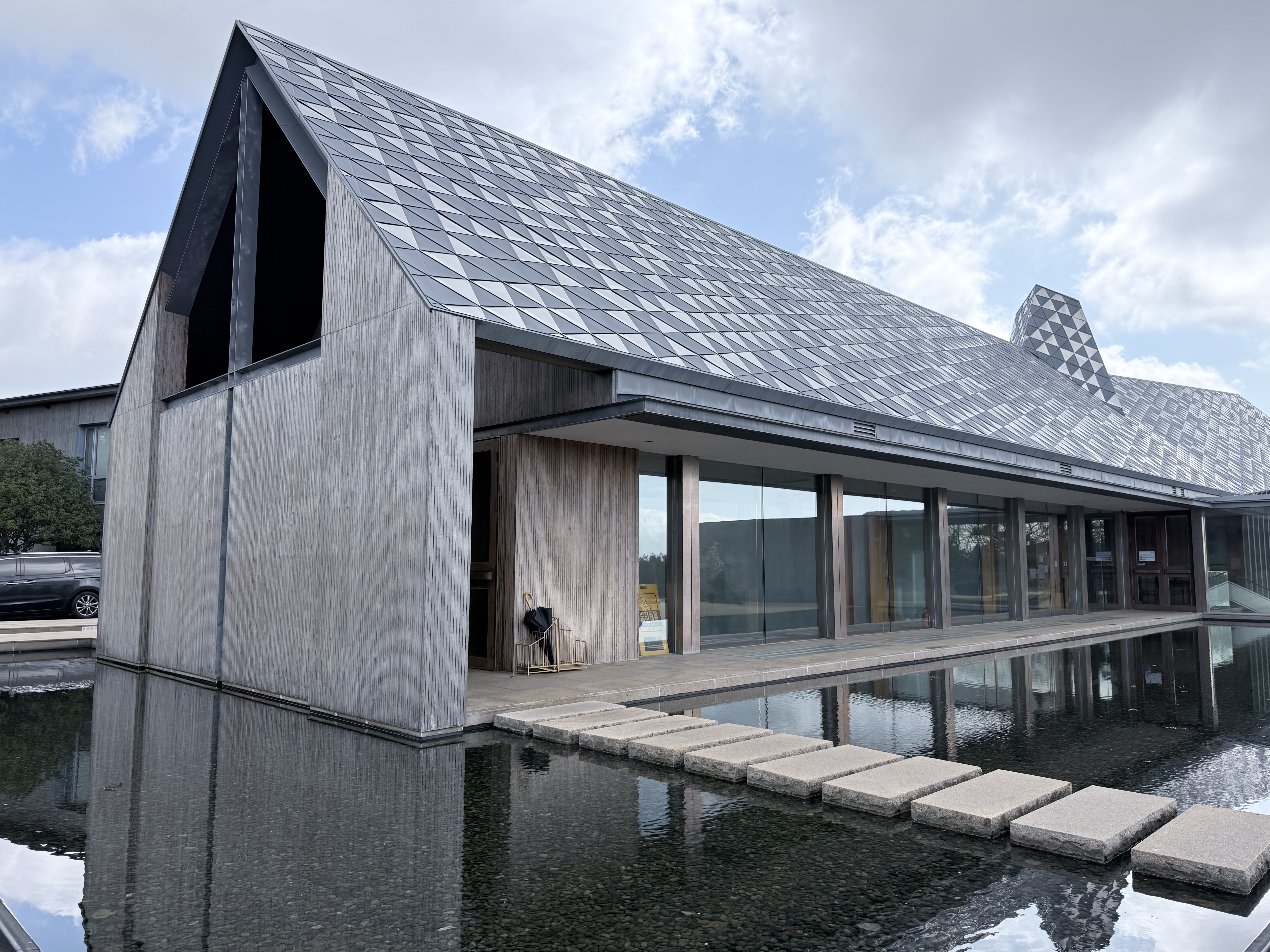
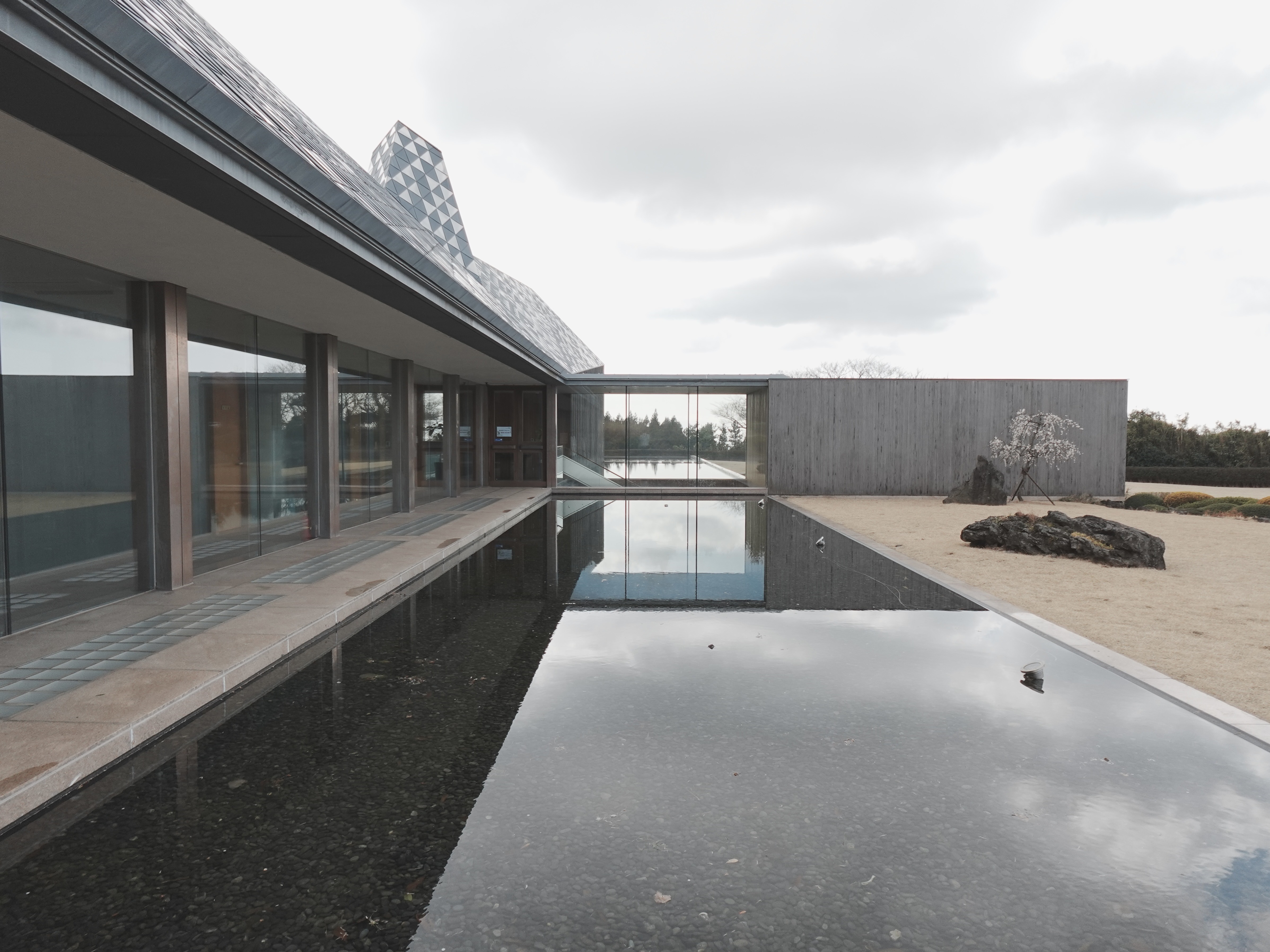
The final stop on this particular tour is Bangju Church(Bangju Gyohoe), which falls outside the Jeju Pilgrimage Trail but deserves a place on any thoughtful visitor's itinerary. It is also, I'd note, an ideal destination for traveling with non-Christian companions — accessible, visually stunning, and naturally conversation-starting without being off-putting.
Bangju Church was designed by Itami Jun, a Korean-Japanese architect who worked across both countries, and his concept was drawn from one of the most theologically loaded images in all of Scripture: Noah's Ark. The building was completed in 2009 and received a prestigious architecture award in 2010. Today it draws visitors from across the world — I encountered Chinese tourists during my visit, which is, in its own way, a testament to how far its reputation has spread.
Some Christians feel uncomfortable with the idea of a church becoming a tourist destination. I understand that instinct. But I'd gently push back on it. A functioning worship space that remains open to the public on weekdays — where unbelievers wander in out of architectural curiosity and find themselves standing in a room shaped by a biblical narrative — seems to me like a providential opening rather than a compromise. The church is not marketing itself. It is simply remaining present, and presence has always been one of the church's most important callings.
The exterior grounds are open at all hours. The sanctuary interior is open Tuesday through Friday, 9:00 AM to 5:00 PM, and on Wednesdays from 1:00 to 5:00 PM. Wednesday prayer service is held at 11:00 AM — and if your travel schedule permits, attending a midweek service at Bangju Church would be a genuinely memorable experience.
Jeju, Seen Through the Eyes of Faith
I've been to Jeju more times than I can easily count. And I'll admit, with some embarrassment, that most of those visits looked very much like everyone else's — beautiful meals, dramatic coastal views, and very little that could be called pilgrimage. This most recent trip changed something in my thinking.
We are not merely tourists who happen to be Christians. We are pilgrims who sometimes travel to beautiful places. That distinction matters. Jeju's landscapes — the volcanic peaks, the black rock coastlines, the windswept plains — are not incidental backdrops. They are the very terrain through which the gospel was carried, across which martyrs walked, and upon which a community of faith was slowly, painfully, faithfully built.
If you're planning a trip to Jeju, I'd encourage you to build some of these stops into your itinerary. Not as an obligation. Not as a performance of piety. But as an act of remembrance — a way of saying, I know whose footsteps I'm walking in, and I have not forgotten.
About Author

faith.log
A journal that connects faith and everyday life. In each small piece of writing, we share the grace of God and the depth of life together.


