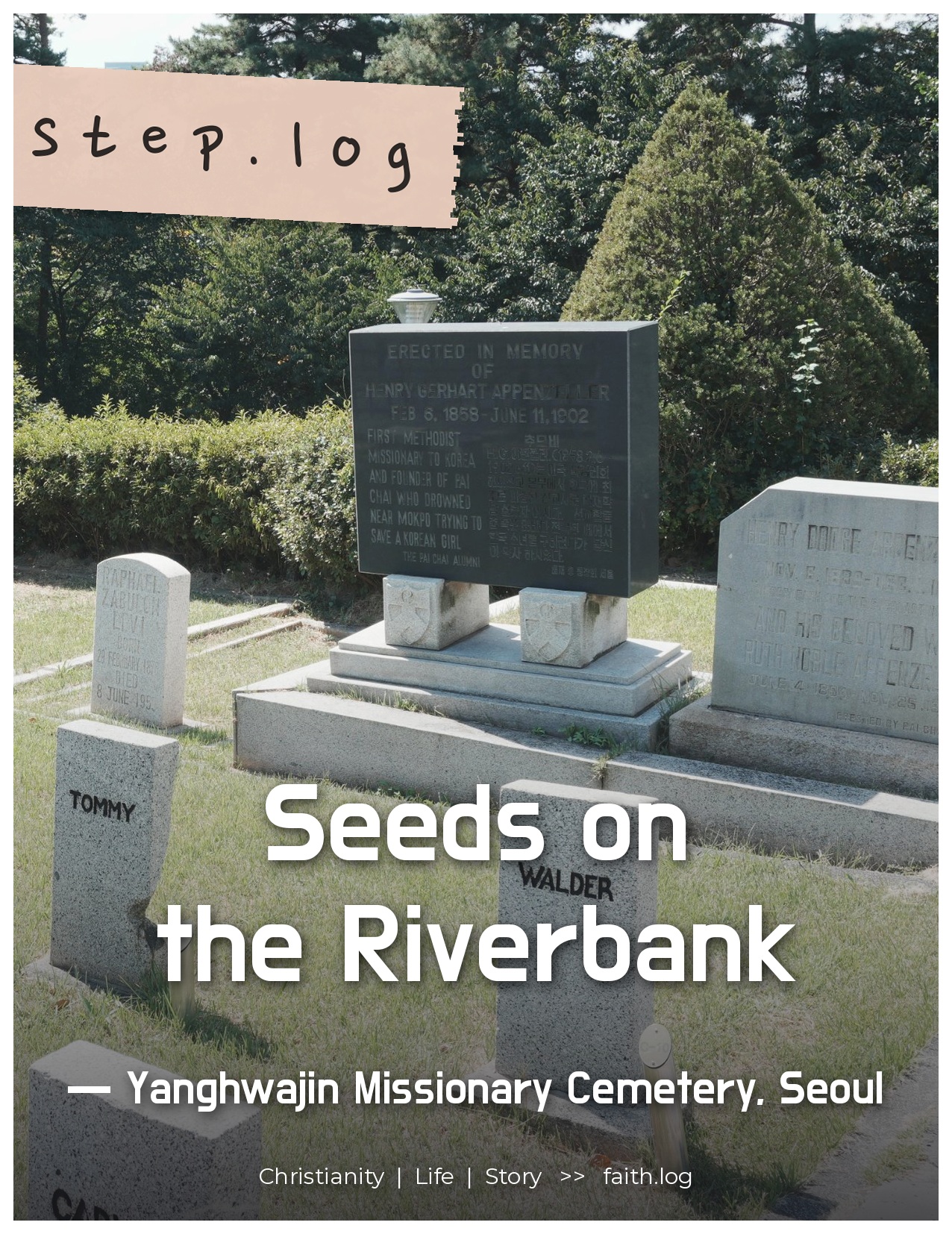
Walking the graves, the memorial chapel, and the exhibition hall above the Han River
There is a hill in western Seoul where the old city once met the river. For centuries, Yanghwa Ferry was one of the main gateways into the Joseon capital, a busy landing where grain, salt, and travelers came and went. Today the hill is ringed by high-rises and coffee shops, but on its slope rest 417 people from fifteen nations. In my last step.log piece, I wrote about the Sherwood Hall Cultural Space on Korea’s east coast and noted that the Hall family’s actual gravestones stand in Seoul. This time I followed that thread to its end, to the Yanghwajin Foreign Missionary Cemetery.
A Riverside Bluff Became a Resting Place for Strangers in 1890
The cemetery began with a death. In July 1890, John W. Heron, a medical missionary sent by the Presbyterian Church in the U.S.A., died of dysentery. The small foreign community in Seoul had nowhere to bury him, and at the request of the American legation, the Korean government set aside this bluff over the Han River. Heron became the first missionary laid to rest here.
Over the following century and more, missionaries, their families, diplomats, and teachers joined him. Of the 417 people buried here, 145 are missionaries and their family members. The cemetery survived Japanese colonial rule and the Korean War, though not without scars. In 2006 it received its current official name.
What strikes an American visitor first is how familiar it looks. Instead of the earthen burial mounds you find on Korean hillsides, there are upright headstones in English, set in neat rows on the grass, much like a churchyard in Pennsylvania or New Jersey. Crosses, rough-cut boulders, small square markers: the shapes vary, but every stone seems to face the same direction.
The Inscriptions Tell Us What These Lives Were For
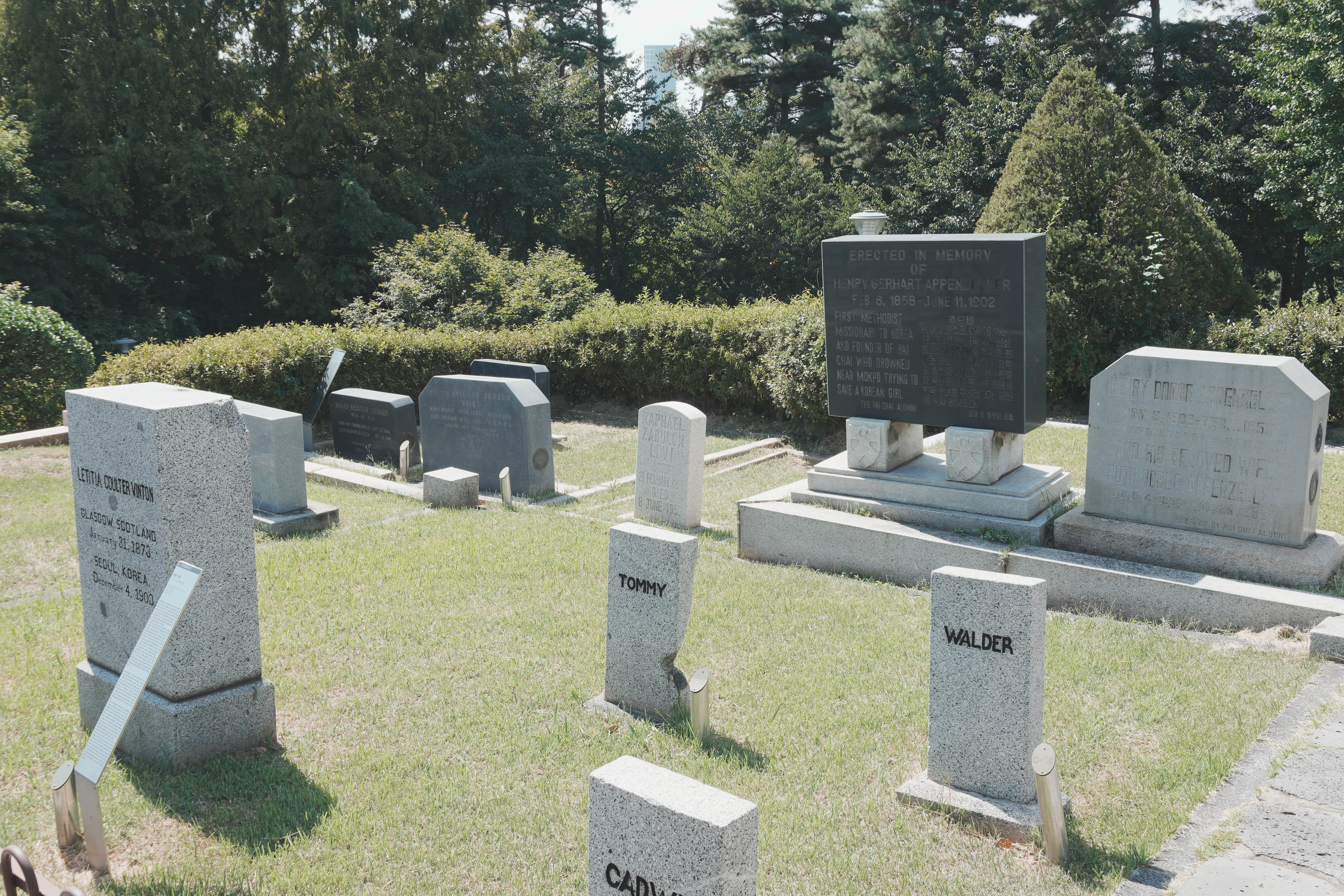
I lingered longest before a black granite monument to Henry Gerhart Appenzeller. A Pennsylvania-born Methodist, he stepped ashore at Chemulpo on Easter Sunday 1885 alongside the Presbyterian Horace Underwood, and went on to found Pai Chai, one of Korea’s first modern schools. In 1902, while traveling south for a Bible translation meeting, his ship collided with another vessel and sank. The inscription says he drowned trying to save a Korean girl. His body was never recovered. The stone, raised by Pai Chai alumni, marks an empty grave. His son Henry Dodge Appenzeller and daughter-in-law Ruth lie beside it.
Nearby stands the stone of Letitia Coulter Vinton. It carries only two places: Glasgow, Scotland, where she was born in 1873, and Seoul, where she died thirty years later. A whole life is stretched between two city names. Around her are smaller markers bearing a single first name and nothing more. Many missionary children who came with their parents never left this hill.
The Hall family is here too. Rosetta Sherwood Hall, who buried her husband and her young daughter Edith in Korea, asked to be laid beside them. Three generations, six members of the family, now rest together. Seeing again the line I first read in Hwajinpo, “So whether we live or die, we belong to the Lord” (Romans 14:8, NLT), on this hillside gave it a weight I had not felt before.
Some inscriptions here are well known. Homer Hulbert, who pleaded Korea’s cause before the world, said he would rather be buried in Korea than in Westminster Abbey. Ruby Kendrick, who died at twenty-five, is remembered for saying that if she had a thousand lives, she would give them all to Korea. None of them treated Korea as a posting. They treated it as the place to spend everything.
The Westminster Shorter Catechism answers its thirty-seventh question with a sentence I find hard to read anywhere else without thinking of this hill: “The bodies of believers, being still united to Christ, do rest in their graves till the resurrection.” Yanghwajin is not where these stories end. It is where they wait. Like the saints of Hebrews 11, they saw the promise from a distance and confessed that they were foreigners and nomads on earth (Hebrews 11:13).
The Memorial Chapel Stands Under a Word About Servanthood
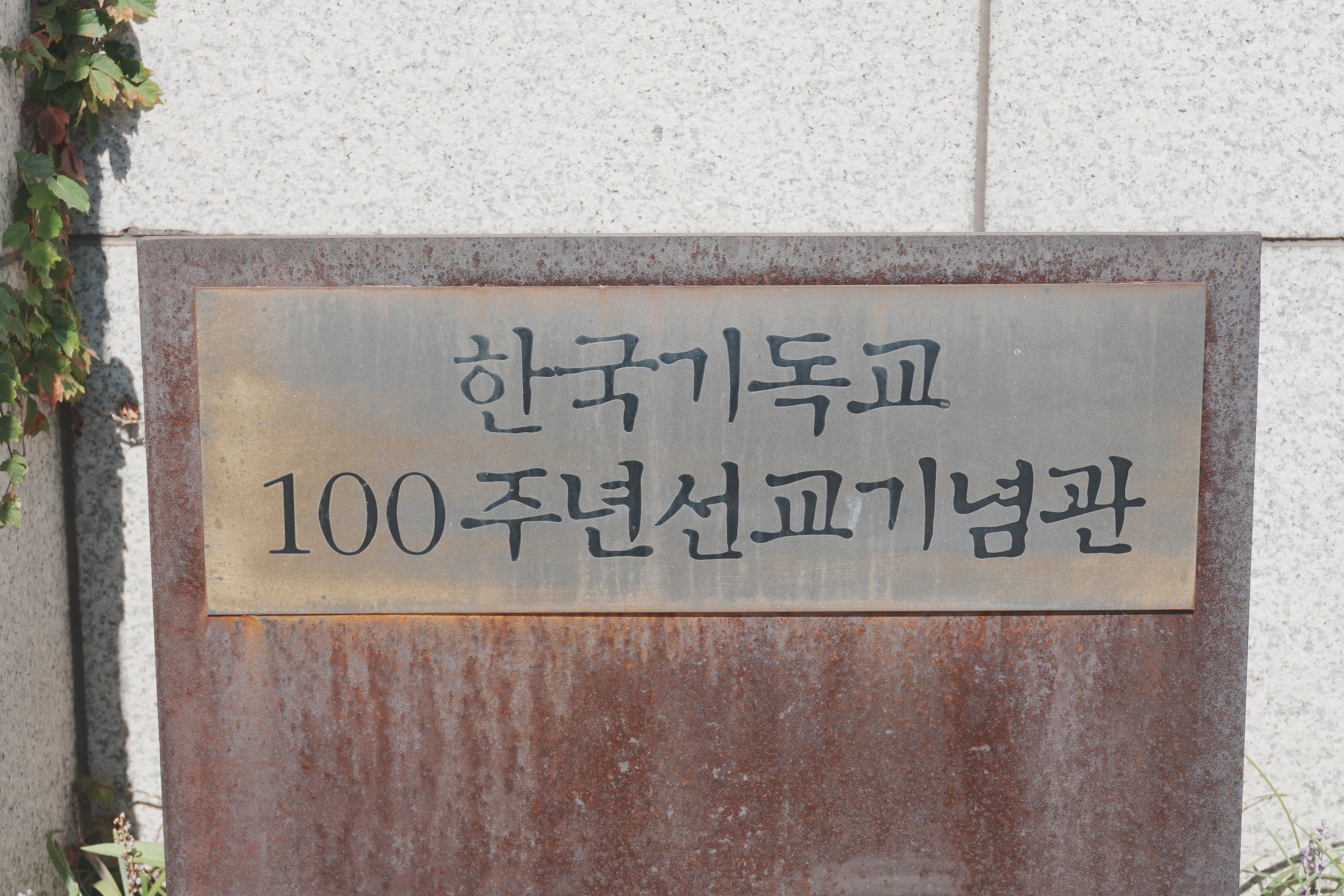
Above the graves rises a granite building marked with a weathered steel plaque: the Korean Christian Centennial Mission Memorial Hall. It was built in the mid-1980s to mark one hundred years of Protestant mission in Korea. Its stepped facade climbs toward a cross, with a narrow column of stained glass running up its center. The building now houses a congregation founded in 2005 for one stated purpose: to care for this cemetery and for the national Christian martyrs’ memorial south of Seoul. Tending these graves is the reason the church exists.
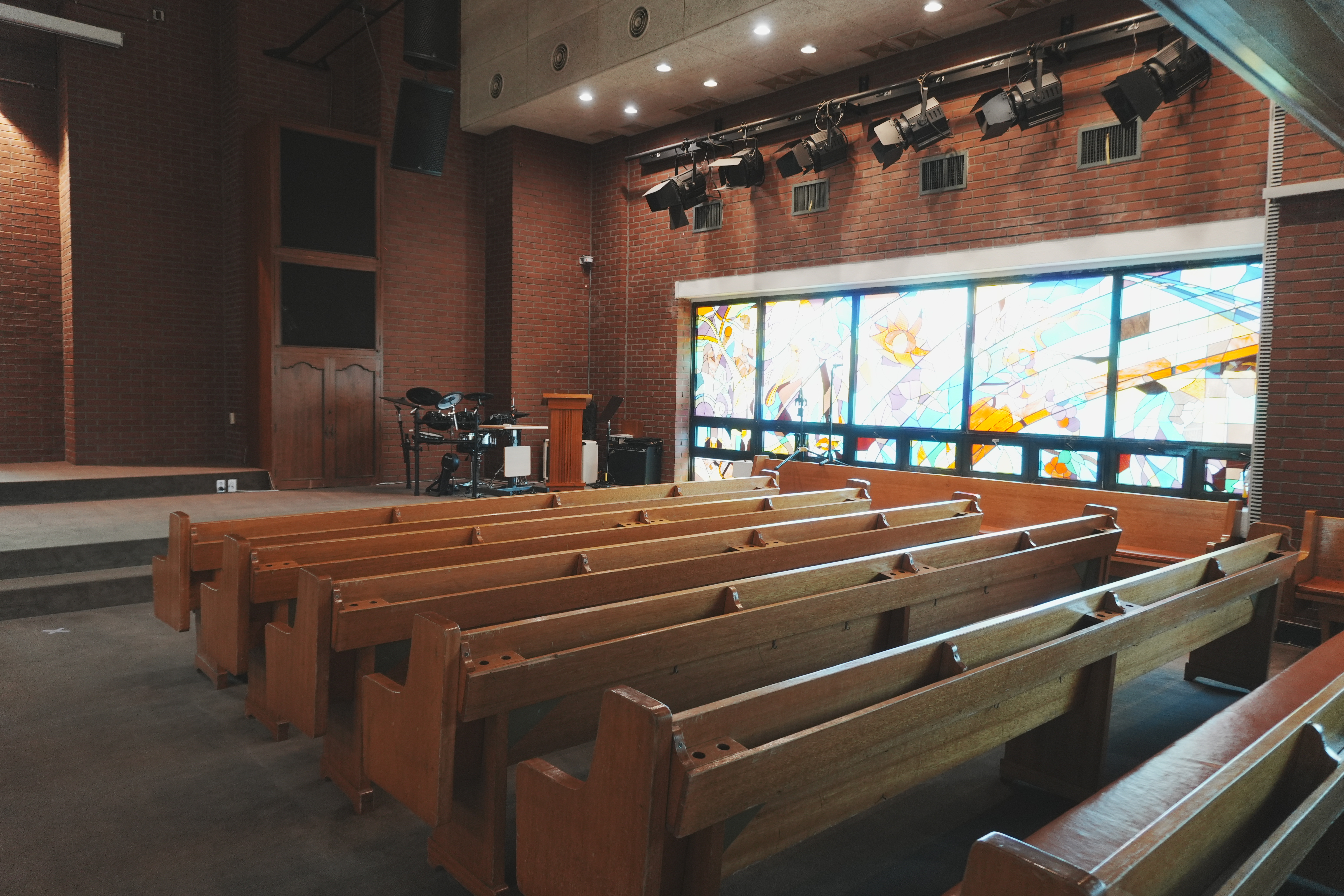
Inside, warm red brick surrounds the sanctuary. The stained glass column continues behind the pulpit, and a long horizontal fixture crosses it to form the shape of a cross. A wide band of colored glass lights the side wall. There is little ornament here, and that seems right. Beside the pulpit hangs a plaque with Jesus’ words: “Whoever wants to be first among you must become your slave” (Matthew 20:27, NLT). I can think of no better summary of the lives buried just down the slope.
I should say plainly that I do not think of Yanghwajin as holy ground. The Reformed tradition has never located holiness in soil or stone. What makes this hill worth the visit is not the hill itself but the Christ to whom these men and women pointed for the whole of their lives. The chapel is most faithful to its purpose not as a monument but as a place where the Word is still preached on the Lord’s Day.
The Exhibition Traces the Gospel Into Schools, Clinics, and Scripture
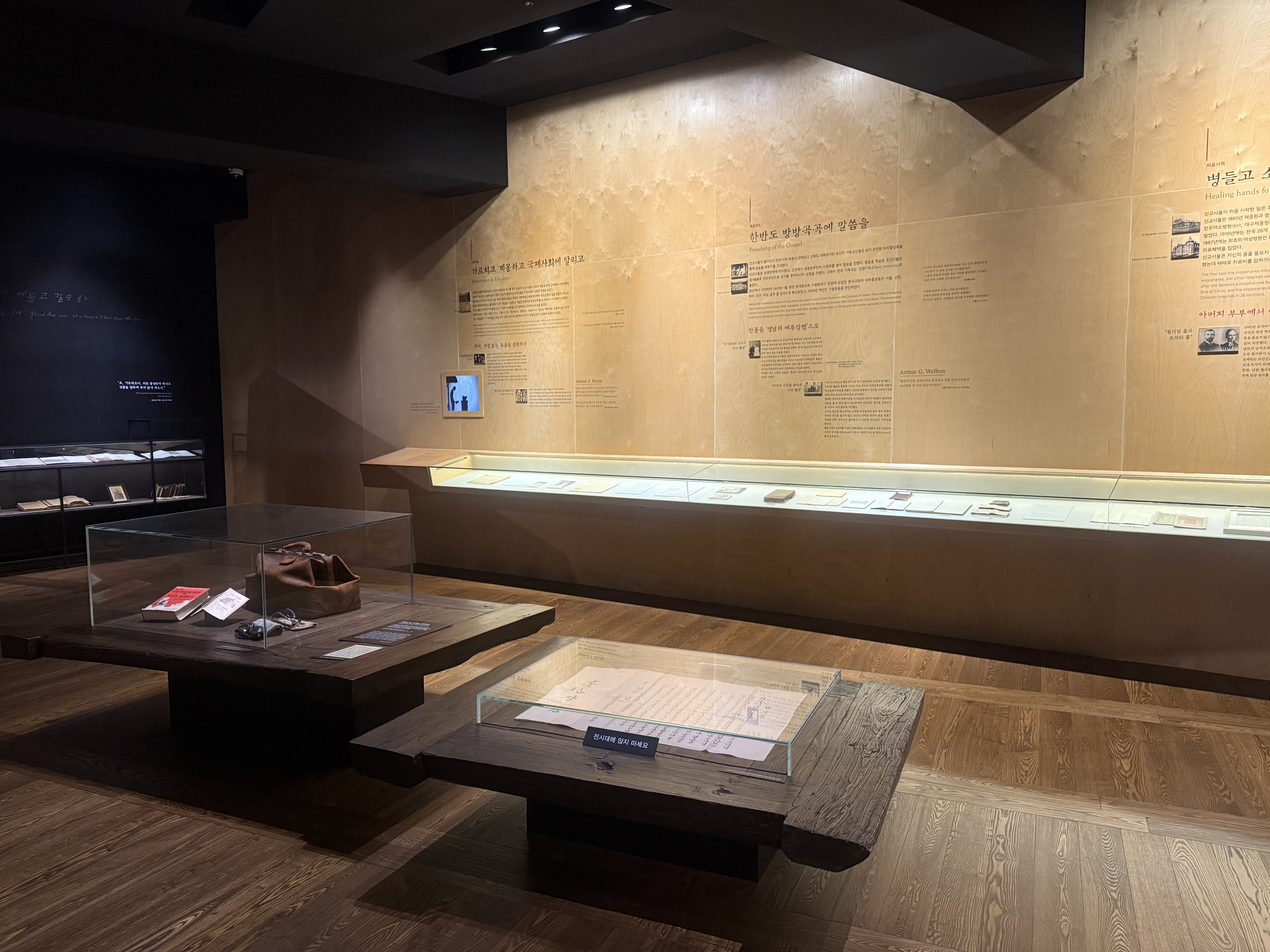
For a fuller picture, the Yanghwajin Hall exhibition is worth an unhurried hour. Under low light, on dark wooden floors, the walls are organized by theme: education and advocacy, the spread of Scripture across the peninsula, and medical work among the sick and the forgotten. Names that may be unfamiliar to American readers appear here, such as Samuel F. Moore, the Presbyterian who preached to Korea’s outcaste butchers, and Arthur G. Welbon, who helped turn the inland city of Andong into what Koreans came to call “the Jerusalem of the southeast.”
At the center of the room, a glass case holds a worn leather doctor’s bag, a stethoscope, and a red-covered book: Sherwood Hall’s memoir, With Stethoscope in Asia: Korea. Having just written about Hall’s stethoscope on the east coast, I found the case a fitting place to close the circle.
Walking through these rooms, I was reminded that the schools and hospitals were never side projects to the “real” mission. Abraham Kuyper famously said there is not a square inch of human existence over which Christ does not cry, “Mine!” These missionaries lived out that claim in classrooms, clinics, and at translation desks. The gospel they carried did not stop at the soul. It reached into every sphere of life.
Yanghwajin Asks What Kind of Seed We Will Become
As I walked back down toward the river, one verse kept returning to me: “I tell you the truth, unless a kernel of wheat is planted in the soil and dies, it remains alone. But its death will produce many new kernels, a plentiful harvest of new lives” (John 12:24, NLT). Most of those buried here never saw the harvest. Yet from the places where they fell grew schools, hospitals, and churches, and the Korean church today stands on that harvest.
Yanghwajin does more than remember. It asks a question of every visitor: What are you living for, and where do you hope to be laid down? If you ever find yourself in Seoul, climb this hill above the Han and let that question find you.
Visitor Information
- Address: 46 Yanghwajin-gil, Mapo-gu, Seoul
- Access: About a 10-minute walk from Hapjeong Station (Lines 2 and 6), Exit 7
- Hours: Monday to Saturday, 10:00 a.m. to 5:00 p.m.; closed Sundays; free admission
- Guided tours: Available in English with advance online reservation
About Author

faith.log
A journal that connects faith and everyday life. In each small piece of writing, we share the grace of God and the depth of life together.


