
Walking Dogo Onsen with Botchan in Hand
Readers who have followed faith.log’s read.log column will remember Botchan, Natsume Sōseki’s comic novel of a hot-headed young teacher sent to the provinces. This installment of spot.log goes to the place that inspired it: Dogo Onsen, the old hot-spring quarter of Matsuyama on the Japanese island of Shikoku. There is a particular pleasure in walking into the setting of a book you already love. It adds another layer to small-town travel, the sense that the street in front of you has been read before you arrived. The Dogo this writer found is a hot-spring town, yes, but it is also a neighborhood where a single novel has made its home for more than a century.
A Single Year in Matsuyama Became the Seed of Botchan
Sōseki arrived in Matsuyama on April 9, 1895, to teach English at the local middle school. The town’s great public bathhouse, the Dogo Onsen Main Building, had been completed only the year before. A month after his arrival, he wrote to a friend in plain delight. For eight sen, he reported, you could climb to the third floor for tea and sweets, and the attendants would even wash your hair with soap. His time in Matsuyama lasted barely a year. The following April he moved on to a post in Kumamoto.
A decade later, that year became fiction. Botchan, published in 1906 in the literary magazine Hototogisu, follows a blunt, stubborn young man from Tokyo who takes a job teaching math at a middle school “somewhere in Shikoku” and promptly collides with nearly everyone he meets. The novel never names the town. Anyone who has read it knows, though, that the town is Matsuyama, and Matsuyama has made sure no visitor can forget it.
The Novel’s “Sumida Hot Spring” Still Stands as the Dogo Onsen Main Building
In the novel, Dogo Onsen appears under the name “Sumida Hot Spring.” The narrator finds nearly everything in town hopelessly inferior to Tokyo, but he concedes that the baths are first-rate and goes every single day. Some of the book’s best comedy happens there. His oversized Western towel turns pink in the water, and his students promptly nickname him “Red Towel.” When no one is around, he swims laps across the wide tub, until one day he finds a large notice posted on the wall: No swimming in the bath.

Built in 1894, the Dogo Onsen Main Building became, in 1994, the first public bathhouse ever designated an Important Cultural Property of Japan. After five and a half years of conservation work begun in 2019, it fully reopened in July 2024. The novel lives on inside it. In the men’s side of the Kami-no-Yu bath, a placard reads Botchan, no swimming. The towels the bathhouse lends and sells are red, a nod to the narrator’s unfortunate nickname. On the third floor is the Botchan Room, a small memorial to the author. It was named in 1966 by the writer Matsuoka Yuzuru, Sōseki’s son-in-law, and it displays Sōseki’s formal marriage-meeting portrait, a bust of the novelist, and photographs of the real people said to have inspired characters like Madonna.
The Streets Around the Bathhouse Hold the Novel’s First Line and Its Characters
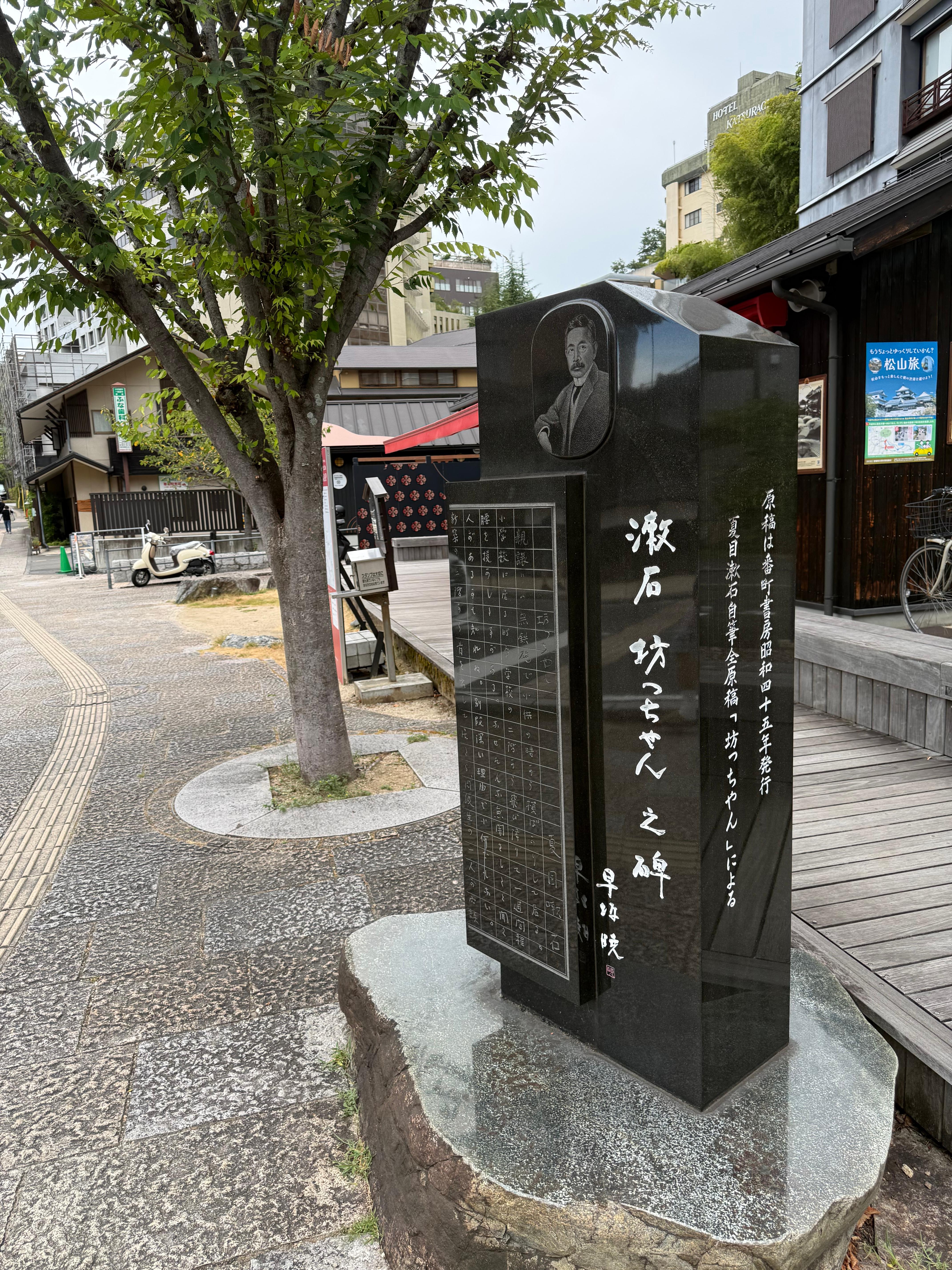
Along the street on the east side of the Main Building stands the Sōseki Botchan Monument. Carved into it, square by square on a grid like a writer’s manuscript paper, is the novel’s famous opening line: “Thanks to the reckless streak I inherited from my parents, I have been losing out ever since I was a boy.” The characters are taken from Sōseki’s own handwritten manuscript. For anyone who knows the book, that one sentence is enough to summon the whole personality of its narrator.
Nearby in the shopping arcade, the novel’s cast stands together as a row of painted figures: Botchan himself and Madonna; Yamaarashi, the loyal colleague; Red Shirt, the scheming head teacher; Nodaiko, his toadying sidekick; Tanuki, the principal; and Uranari, the gentle teacher who loses Madonna. Seven in all. A bench in front invites you to sit down and take a picture with them, and readers get the extra fun of matching each figure to its name.
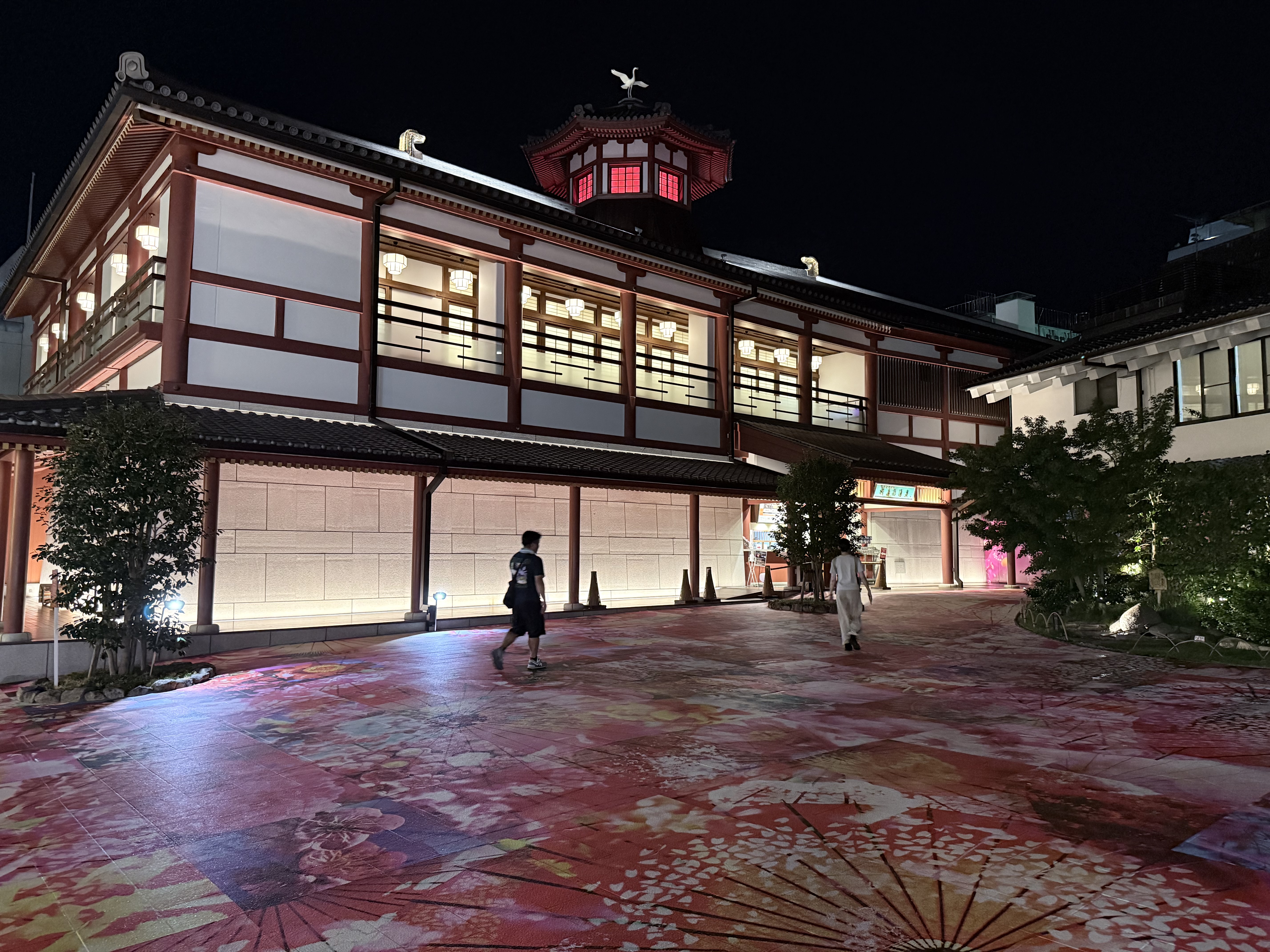
A short walk from the Main Building brings you to Asuka-no-Yu, an annex bathhouse opened in 2017 to welcome visitors while the old building was under repair. Its design borrows from Japanese architecture of the seventh century. In the courtyard stands a reconstruction of an ancient stone inscription, said to commemorate a visit by Prince Shōtoku, who praised the spring and its scenery. The spot is a reminder that Dogo was a setting for stories and verse long before Sōseki ever stepped off the train. The vivid floral imagery currently covering the pavement and windows of the area is the work of photographer Mika Ninagawa, on display throughout Dogo through the end of February 2027.
The Dango of Haikara-dori Carry a Scene from the Novel into the Present
Between Dogo Onsen Station and the Main Building runs a covered shopping street known as Haikara-dori. Its signature treat is Botchan dango. In the novel, the narrator buys a plate of dango at a shop in the hot-spring town, only to walk into his classroom the next day and find “Two plates of dango, seven sen” scrawled across the blackboard. For a man who complains about nearly everything in the countryside, the dango are one of the few things he admits are good. In the Taishō era, local confectioners turned that scene into a three-colored sweet, and it has since become Dogo’s best-known souvenir. Step out of the bath with a skewer in hand, and it is hard not to picture the narrator trying to eat his dango without being spotted by his students.
In Front of Dogo Onsen Station, the “Matchbox Train” Still Waits

If you come to Dogo by public transit, your trip begins at Dogo Onsen Station. The station opened in 1895, the same year Sōseki arrived, and the present building is a restoration of the original 1911 structure. In the novel, the narrator lands at the port by steamer and transfers to a tiny train into town. He calls it a train “like a matchbox” and grumbles that no sooner had it started than it was time to get off.
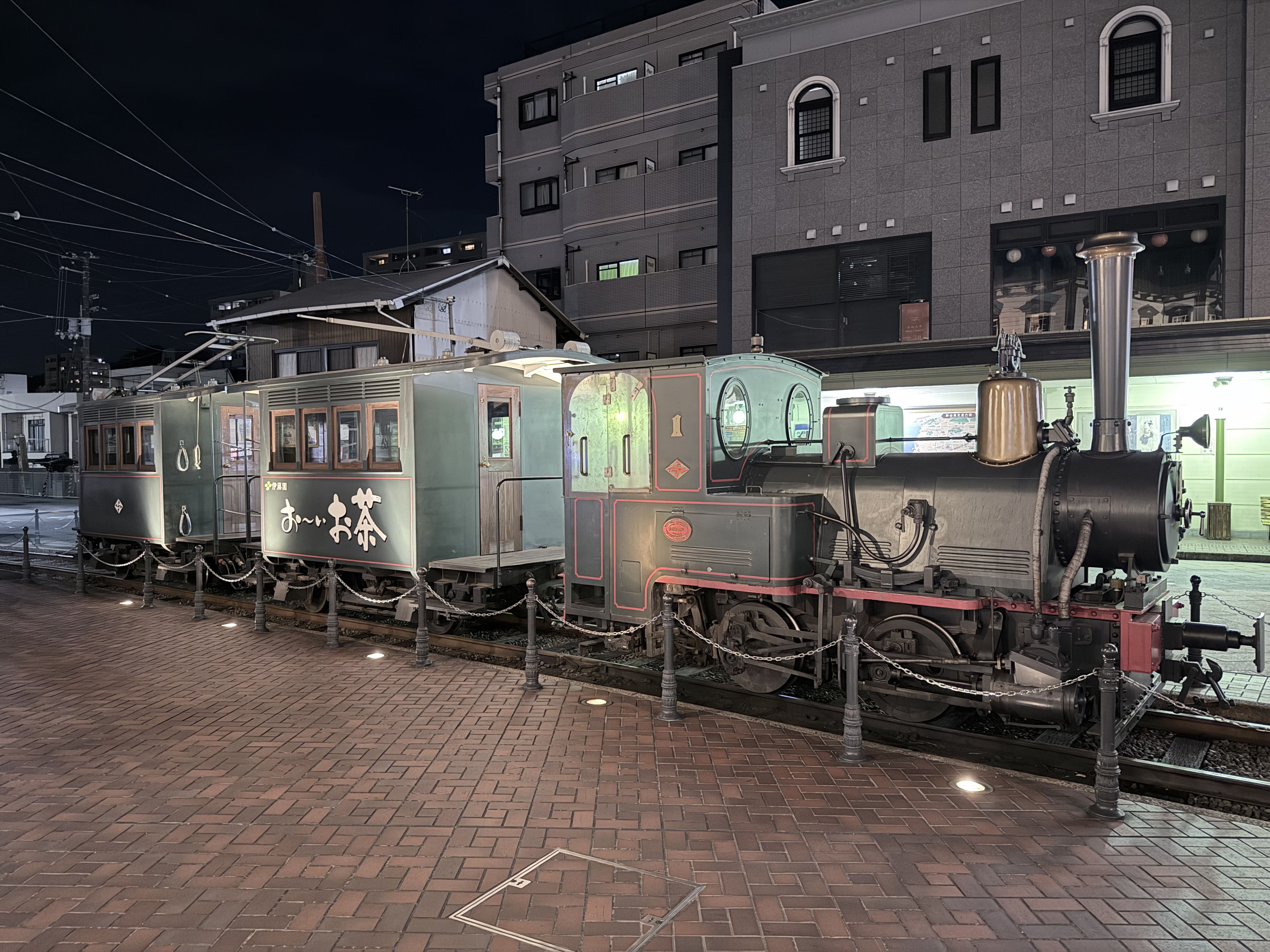
That train runs again today as the Botchan Train. Re-created in 2001 from the original design, it now runs on diesel, though its smokestack still puffs steam to play the part. It operates only on weekends and national holidays. On other days it sits in front of the station, where you can see it up close.
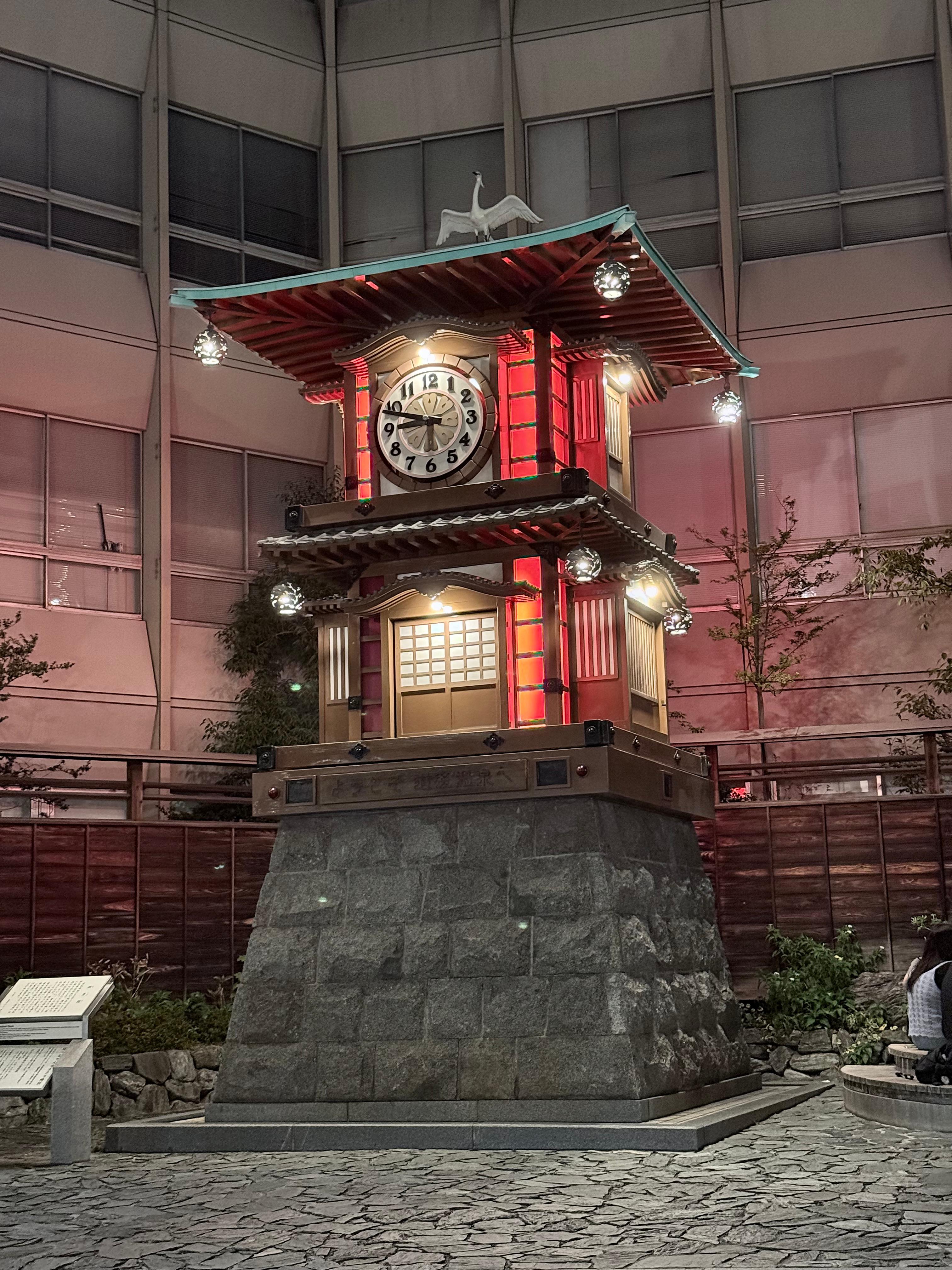
In Hōjōen, the small plaza in front of the station, stands the Botchan Karakuri Clock. Built in 1994 to mark the Main Building’s centennial, it is modeled on the Shinrokaku, the turret that crowns the bathhouse roof. Every hour on the hour from 8 a.m. to 10 p.m., the clock rises to music, and figures of the novel’s characters and a few bathers emerge one after another. On weekends and holidays, throughout March, April, August, and November, during Golden Week, and over the New Year season, the show runs every thirty minutes. Beside the clock is a free footbath, a fine place to rest your feet while you wait for the next performance.
Traveling with a Book Changes How You Read a City
Dogo Onsen is worth the trip for its waters alone. But walk these streets after reading Botchan and the same scenery looks entirely different. The placard on the bath wall, the red towels, a skewer of dango, and a little matchbox train all come back to life as scenes from a story. If Matsuyama is on your itinerary, this writer suggests packing a copy of Botchan. Read it before you go, or read it after your bath with your feet in the footbath. And for what this novel still has to say to readers today, see faith.log’s read.log review of Botchan.
About Author

faith.log
A journal that connects faith and everyday life. In each small piece of writing, we share the grace of God and the depth of life together.


